Upon the Ashes of Babylon Parts 1-3 and Other Poetic Teachings: Muslim Spoken Word Artist, Amir Sulaiman

Last Updated 10-24-24

Image credits: https://www.amirsulaiman.com/

11 Video Playlist

Trk# 1-3 is an entire talk entitled “Upon the Ashes of Babylon” from a powerful Muslim spoken word artist, Amir Sulaiman. The event was part of Islam Awareness Week 2006 at the University of Alberta in Edmonton, AB, Canada. Amir’s words manifest a quiet confidence which I find compelling. He has a way of framing issues which is really cathartic and healthy… it reminds me of how I felt when I read Malcolm’s speeches for the first time.

https://www.amirsulaiman.com/contact

A native of Rochester, New York, writer, activist, and educator Amir Sulaiman is a member of Goodestuff Entertainment, an Atlanta based collective providing culturally relevant programming. With a political consciousness that is profound without being preachy and stately without being stand-offish, Sulaiman has garnered the respect of such notables as Kevin Powell who invited the riveting performer to open for his State of Black Men in America Tour Kickoff held at Rev. Dr. Barbara King’s Hillside Chapel and Truth Center. Even media mogul Russell Simmons sat in awe as Sulaiman dropped science to a fervent audience during a recent taping of HBO’s Def Poetry. In addition to writing and recording, Sulaiman gives presentations and workshops. His presentation, The 40 Year Itch: The Harlem Renaissance, The Black Arts Movement and Modern Spoken Word, grounds the burgeoning spoken word movement in cultural, historic, and literary roots. He also molds the minds of youth teaching the elements of poetry, the power of voice, and style development. In his Communication Workshop, he explores the intricacy of human language and the process by which ideas travel from one mind to another. Sulaiman was an active participant in Goodestuff Entertainment’s First Annual Southern Poetry Conference held at the historic Auburn Research Library as well as the Atlanta Congressional Debate.

Amir Sulaiman began writing poetry at the age of twelve. In 1996, he began performing at colleges, universities, bookstores, and coffee shops as a student at North Carolina A&T. In his sophomore year, he released his debut poetry collection Words of Love, Life, and Death. This early work distends across the broad canvas of truth, struggle, relationships, and poetry. During his tenure at NC A&T, Sulaiman’s work was published in literary journals and collections including The Hazmat Review, All That Jazz, and Sauti Mypa. After obtaining a B.A. in English from North Carolina A&T he moved to Atlanta, G.A and released his breakthrough CD “Cornerstore Folklore”. Bolstered by the success of Cornerstore Folklore Tour– which reached such cities as D.C., NY, Oakland, San Francisco, Norfolk, Richmond, Philadelphia, Baltimore, Raleigh, Greensboro—Sulaiman began whispering in the same breath of elders like Amiri Barka and solidified himself as a voice of light in the midst of a dark day.

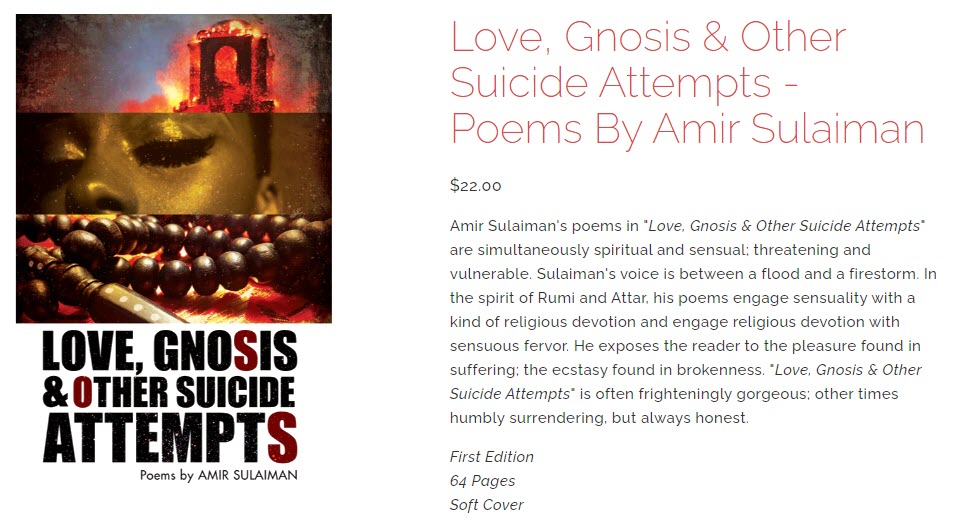
Buy his Book Here: Love, Gnosis & Other Suicide Attempts – Poems By Amir Sulaiman
For more like this visit RBG Communiversity’s eLibrary | Hip Hop/Rap Music _ eBooks & Video Edu Folder

Assata: In her own words and Assata (Shakur), An Autobiography (eBook and Audiobook), with Her RBG Video Edu. Player

Updated, October 11, 2024

Click for standalone poster.

15 Video Playlist

Assata: In her own words

My name is Assata (“she who struggles”) Shakur (“the thankful one”), and I am a 20th century escaped slave. Because of government persecution, I was left with no other choice than to flee from the political repression, racism and violence that dominate the US government’s policy towards people of color. I am an ex political prisoner, and I have been living in exile in Cuba since 1984. I have been a political activist most of my life, and although the U.S. government has done everything in its power to criminalize me, I am not a criminal, nor have I ever been one. In the 1960s, I participated in various struggles: the black liberation movement, the student rights movement, and the movement to end the war in Vietnam. I joined the Black Panther Party. By 1969 the Black Panther Party had become the number one organization targeted by the FBI’s COINTELPRO program. Because the Black Panther Party demanded the total liberation of black people, J. Edgar Hoover called it “greatest threat to the internal security of the country” and vowed to destroy it and its leaders and activists.

Assata Shakur has been living in Cuba since 1986, after escaping from prison where she was serving a life sentence imposed in a highly disputed trial. Assata was a Black Panther then a Black Liberation Army (BLA) leader in the early ’70s, so she was a target of the FBI’s COINTELPRO operation. Assata was captured in a shoot-out resulting from resistance to yet another “driving while black” police action in 1973 on the New Jersey State Turnpike. This time a State Trooper was killed. Zayd Shakur, traveling in the car with Assata, was also killed. The third person in the car, Sundiata Acoli, is still serving time over 20 years later and has recently been denied parole for another 20 years. According to one of Sundiata’ attorney, Joan P. Gibbs, “Assata, at the time of her arrest, was ‘wanted’ on federal and state charges in New York, all of which juries subsequently found her not guilty of or were dismissed.” “The idea of the Black Liberation Army emerged from conditions in Black communities: conditions of poverty, indecent housing, massive unemployment, poor medical care, and inferior education. The idea came about because Black people are not free or equal in this country. Because ninety percent of the men and women in this country’s prisons are Black and Third World. Because ten-year-old children are shot down in our streets. Because dope has saturated our communities, preying on the disillusionment and frustrations of our children. The concept of the BLA arose because of the political, social, and economic oppression of Black people in this country. And where there is oppression, there will be resistance. The BLA is part of that resistance movement. The Black Liberation Army stands for freedom and justice for all people.

Assata By: Assata Shakur eBook

Pop the document out from the upper right to read / expand / download.

Assata By: Assata Shakur Audiobook, Angela Davis – foreword

Part 1

Part 2

Learn more in RBG Communiversity Knowledge Media eLibrary Assata Shakur Folder
