
Book Summary
Acknowledgments
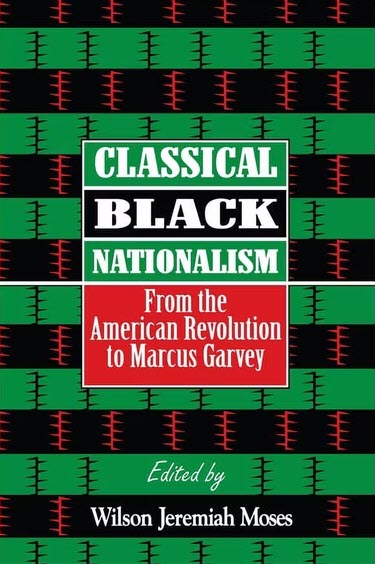
Wilson Jeremiah Moses outlines the book’s purpose as a teaching text focused on the self-help, Pan-Africanist, and Black Nationalist traditions in African American history.
The author acknowledges colleagues, family members, and editors who assisted in researching and editing the volume.
Introduction: Classical Black Nationalism
Definition of the Concept:
Classical Black Nationalism is defined as the movement between 1850 and 1925 aimed at creating a sovereign Black nation-state with defined geographical boundaries, typically in Africa.
Unlike 20th-century cultural nationalism, 19th-century Black Nationalism was grounded in religious historicism, Divine Providence, and high-culture aesthetic values.
History of the Movement:
Traces the evolution of Black Nationalist thought from late 18th-century petitions (e.g., Prince Hall) and the Haitian Revolution to 19th-century emigration debates.
Details key historical developments, including Paul Cuffe’s early repatriation plans, Black opposition to the proslavery American Colonization Society (ACS), the nationalist resurgence following the Fugitive Slave Act of 1850 and Dred Scott decision, and Marcus Garvey’s movement in the 1920s.
Bibliographic Note:
Highlights foundational texts and scholarly literature on Black nationalism, Pan-Africanism, and Afrocentricity.
Part One: The Colonization and Emigration Controversy, Preclassical Period
Notes on the State of Virginia (1781–82) by Thomas Jefferson:
Jefferson outlines a proposal to gradually emancipate enslaved Black people and deport them to a separate colony, arguing that racial prejudice and natural distinctions prevent peaceful integration into American society.
Letters to Peter Williams Jr. (1816) and James Forten (1817) by Paul Cuffe:
Paul Cuffe details efforts to establish commercial trade and migration networks between free Black Americans and Sierra Leone.
Letter to Paul Cuffe (1817) by James Forten:
Forten highlights the intense opposition among free Black Philadelphians toward forced colonization by the American Colonization Society, while privately acknowledging his belief that Black people must separate to achieve true independence.
Mutability of Human Affairs (1827) (Freedom’s Journal):
Explores the historical rise and fall of ancient empires, pointing to ancient Egypt and Ethiopia as Black-led centers of civilization and predicting an eventual restoration of Black national dignity.
The Ethiopian Manifesto (1829) by Robert Alexander Young:
Uses prophetic and messianic language to condemn slaveholders, warn of divine judgment, and predict the arrival of a divine leader ordained to unite Black people into a sovereign nation.
An Appeal in Four Articles (1830) by David Walker:
Delivers a passionate critique of American slavery, compares Black Americans to the biblical Israelites, rejects forced colonization to Africa, and calls for Black unity, self-education, and resistance against oppression.
Address at the African Masonic Hall (1833) by Maria Stewart:
Condemns white oppression while calling on Black men and youth to abandon trivial distractions, pursue moral and intellectual advancement, and fearlessly fight for their rights.
Pop the document out from the upper right to read / expand / download


You must be logged in to post a comment.