Two Types of Scholars in The Global African Community
“There are two types of fundamental scholars within the world of African people. There are those scholars who have internalized the value system of white supremacy. They, generally, never question any theories, models, perceptions, assumptions or concepts that come from the minds of White males in the world. They then proceed to write and teach rooted in the assumption that white scholars cannot be questioned in their social, cultural, philosophical or theological approaches to the human condition. In general their very merit as approval by the white male developed and controlled institutions of higher learning, and they depend on the validation of the white male as the source of their professionalism and views.
This group of scholars within the global African community can command access to the media, major publishing companies, the university lecture circuit, and even access to other nation of Afrikan people. These scholars, in conjunction with a very dishonest mainstream African media in the U.S. , the Caribbean and on the African continent then engage in reinforcing white supremacy simply because that endorsement pays well, supports the business, provides the individual with economic stability and personal notoriety. Even those who take the position of being progressive, liberal and radical only do so within the context of White male cultural thought. They only reference other Afrikans who reference radical, progressive and liberal whites. Such scholars attempt to control the direction of the conversation of African people. They are more prone to talk in ‘universal’ themes, ‘international’ themes, ‘humanism’ themes and ‘class’ themes which are all inventions of the white male mind in their concept, assumptions, values to serve the purpose of his maintenance of human supremacy. Thus the conversation for them is always ‘how do we transcend race to a common dialogue of humanity’ which is always based on how the white world wants to transcend race. For them the goal is for African people to prove to the white world that Afrikan people are worthy of respect, regard and assistance whether that argument is posed from the conservative right or the radical left of white cultural thought. In essence they spend a life time promoting world white nationalism disguised as ‘modernity, technological advancement and social democracy’ as defined by the white male mind. They have not had an original thought ever and denounce original thought as invalid and unrealistic because it does not allow African people to learn how to live in a white cultural and social reality. Their combined force of conversation then attempts to drown out the second type of scholar, the African-centered, Nationalist and Pan-Africanism scholar.
This type of scholar has struggled for two centuries to be heard by African people yet this scholar has had to contend with the power of white supremacy by way of the first scholar, the media preference of the first scholar and the innate selfl-preservation of white male culture that has created a climate and environment to starve his scholar out. This scholar has learned the theories, models, perceptions, and concepts and assumptions of the same schools of the white male thought as the first group of scholars yet this scholar has not only chosen to challenge their fundamental validity but has moved into the direction of replacing them with sound thinking that comes out of an African way of looking at the human condition rooted in those cultural concepts, theories, models, perceptions and assumptions of a fundamentally Afrikan value system. This scholar has been a student of Jeffersonian philosophy, Marxism, Christianity, Islam, capitalism, industrialism, and found all of them to be unAfrikan in nature, sensibility and application. This scholar has started from the position that the white male is not above being challenged in ALL of his theories, models, approaches, assumptions and concepts about anything human.
This scholar takes the position that the white male is no more intelligent than any other group of people on the planet. He has merely had the ability to use seduction, coercion and brutal violence to persuade the rest of humanity that he is the ultimate representative of civilization, human achievement and human aspiration. These scholars, however, have generally worked in isolation from one another, without the advantage of financial support that their peers have received continuously. They have had to struggle against a mainstream African American, Caribbean and continental African media that has been convinced of the credibility that anything worth doing must be a copy of the white male model of human intellect and social organization. These scholars for the most part have not headed any historically Black college departments in America, nor have they been made the heads of such departments in Caribbean and Afrikan universities. Often times these scholars have not only struggled to print their material but to get it advertised inthe mainstream black media.
They have never been featured on mainstream black controlled programming on a regular basis. They have not been offered syndication by the Black media in the U. S. , in the Caribbean or on the Afrikan continent. They have had to pursue an intellectual guerrilla strategy to get exposure in the Black world globally. The power of white male supremacy is such that those Afrikan people on the right of the white male cultural perspective and those on the left of the white male cultural perspective have attacked them with equal venom, and where they have not been attacked, they have been deliberately ridiculed or questioned.
Those who have challenged them have read nothing of Martin R. Delany, Paul Cuffee, Edward Wilmot Blyden, Marcus Garvey, Ida B. Wells, Queen Nzingha, Queen Asantewaa, Cheikh Anta Diop, Denmark Vesey, Nat Turner, etc.. Their books have not been used by the vast majority of Black history courses in the U.S. And of course they have not been approached by most universities in the Caribbean and on the African continent to use their books for courses. Yet this group of scholars has always attempted to put the needs of Afrikan people first, realizing that the other groups on the planet do not need our help, and are generally helping themselves bettter than we are helping ourselves. All of these scholars have started with the assumption that we have enough genius within our ranks to solve our problems if we are willing to think ourside of the Eurocentric cultural box. For them, we need to learn how to think from a position of power; work together to establish a position of power and be able to threaten retaliation from a position of power.”
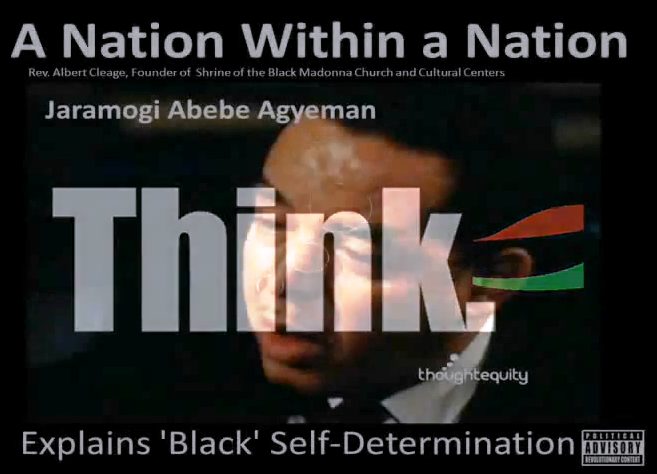
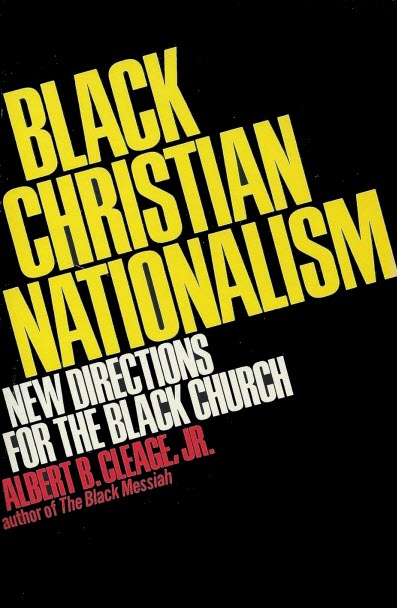
Black Christian Nationalism, By Jaramogi Abebe Agyeman_eBook
Book Summary
“Black Christian Nationalism” by Reverend Albert Cleage, also known as Jaramogi Abebe Agyeman, presents a compelling argument for the integration of Black nationalism and Christianity.
The following overview and outline encapsulates the core themes and arguments presented in Cleage’s work, illustrating his vision for a transformative approach to Christianity that empowers the Black community.
Overview
In “Black Christian Nationalism,” Cleage argues that Christianity can and should be reinterpreted to serve the needs of the Black community. He critiques traditional Christian doctrines that have often marginalized Black experiences and emphasizes the importance of a Black identity within the Christian faith. Cleage advocates for a theology that empowers Black people and addresses social justice, cultural pride, and economic independence.
Introduction
Definition of Black Christian Nationalism
Importance of the intersection between faith and identity
Chapter 1: Historical Context
Overview of Black Christianity in America
Influence of slavery and segregation on Black religious practices
The role of the church in the civil rights movement
Chapter 2: Critique of Mainstream Christianity
Examination of traditional Christian teachings
Discussion of Eurocentrism in theology
Impact of mainstream Christianity on Black identity
Chapter 3: Theological Foundations
Introduction to Black liberation theology
Reinterpretation of Biblical figures as symbols of Black resilience
Emphasis on the African heritage in Christianity
Chapter 4: Political Implications
The relationship between faith and activism
Advocacy for social justice and civil rights
The church as a base for political organization
Chapter 5: Economic Empowerment
Importance of self-sufficiency within the Black community
Strategies for economic independence
Role of the church in promoting economic initiatives
Chapter 6: Cultural Identity
Embracing African cultural heritage
Importance of cultural pride in the Black community
The church as a center for cultural education and celebration
Chapter 7: Vision for the Future
Call for a new understanding of Christianity
Vision for a united Black community grounded in faith
Encouragement for future generations to embrace Black Christian Nationalism
Conclusion
Summary of key arguments
The ongoing relevance of Black Christian Nationalism in contemporary society
Here is a deeper exploration of the themes and concepts presented in “Black Christian Nationalism”
Detailed Themes
1. Historical Context
Evolution of Black Christianity: Cleage discusses how the experiences of African Americans shaped their religious practices, emphasizing the resilience and adaptability of Black Christians throughout history.
Role of the Church: The church served not only as a spiritual refuge but also as a community center, a platform for activism, and a source of leadership during critical movements like the civil rights struggle.
2. Critique of Mainstream Christianity
Eurocentrism: Cleage critiques the predominance of European interpretations of Christianity that often neglect or misrepresent the experiences of Black individuals.
Identity and Faith: He argues that traditional Christian teachings can alienate Black believers, leading to a disconnection from their cultural identity. Cleage calls for a theology that resonates with the Black experience.
3. Theological Foundations
Liberation Theology: Cleage aligns himself with liberation theology, which emphasizes the importance of addressing social and economic injustices as part of the Christian mission.
Biblical Reinterpretation: He encourages readers to find empowerment in the stories of Biblical figures who faced oppression, framing them as relatable heroes for the Black community.
4. Political Implications
Faith and Activism: Cleage emphasizes that faith should lead to action. He believes that churches should engage in political activism to fight for civil rights and justice.
Community Organization: The church can be a powerful organizing force, helping to mobilize individuals towards collective action against systemic oppression.
5. Economic Empowerment
Self-Sufficiency: Cleage advocates for economic independence as a crucial component of liberation. He discusses the importance of creating and supporting Black-owned businesses.
Church Initiatives: The church should lead initiatives that focus on economic education and support for community development, fostering a sense of agency within the Black population.
6. Cultural Identity
Embracing Heritage: Cleage stresses the importance of recognizing and celebrating African roots and cultural practices as integral to the Black Christian experience.
Cultural Education: The church is positioned as a place for cultural education, helping community members learn about their history and identity.
7. Vision for the Future
Transformative Christianity: Cleage envisions a future where Black Christian Nationalism redefines Christianity in a way that uplifts and empowers Black individuals.
Legacy and Leadership: He calls upon the younger generation to carry forward the ideals of Black Christian Nationalism, ensuring that the struggle for justice and equality continues.
Conclusion
“Black Christian Nationalism” is not just a theological treatise; it is also a rallying cry for social justice, cultural pride, and economic independence. Cleage’s work challenges the status quo of both religious and societal norms, advocating for a faith that is deeply rooted in the experiences and struggles of Black people. His vision is one of empowerment, community, and a reimagined relationship with spirituality that honors both identity and faith.
Black Christian Nationalism: New Directions for the Black Church_eBook
Pop the documents out from the upper right to read / expand / download.
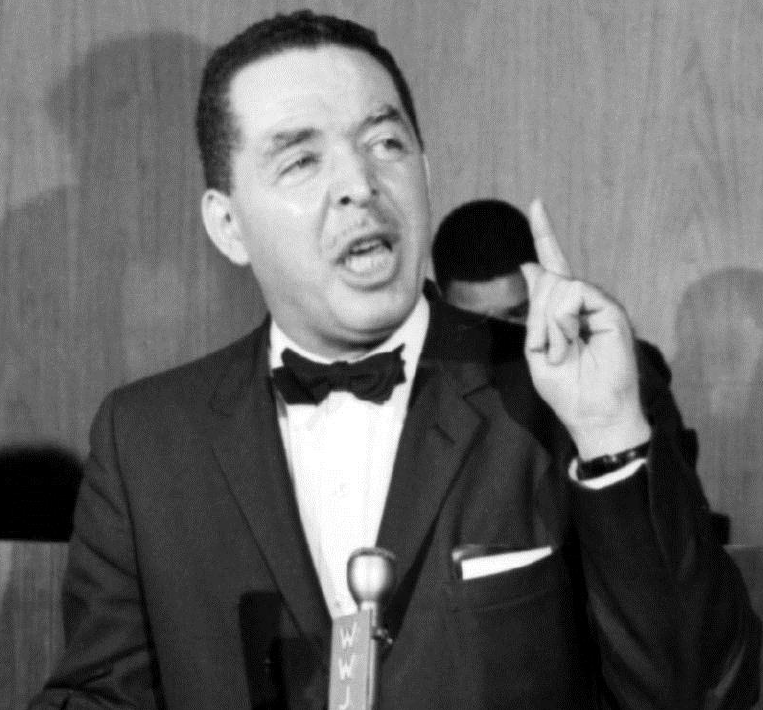
Rev. Albert Cleage, chairman of the Detroit Inner City Organizing Committee, gave this speech at a memorial meeting for Malcolm X at the Friday Night Socialist Forum in Detroit, February 24, 1967.
Learn more in RBG Communiversity Knowledge Media eLibrary:











You must be logged in to post a comment.