
ICEBREAKER FILM
Organization Summary (Web Pages)
Deacons for Defense and Justice (often abbreviated DDJ) was a Black armed self-defense organization founded in Jonesboro, Louisiana in 1964 to protect civil rights workers and Black communities from Ku Klux Klan violence and complicit local police.
Most members were working-class men and veterans of World War II or Korea. They did not seek to start violence; they organized disciplined patrols, guarded homes and Freedom Houses, escorted activists, and shot back when fired upon. Their existence challenged the dominant nonviolence narrative of the civil rights movement and later influenced Black Power thinking.
Founding in Jonesboro DDJ
In summer 1964, CORE organizers arrived in Jonesboro to register voters and challenge Jim Crow. The Klan responded with church burnings, night rides, and intimidation, sometimes with police escort. Informal groups of armed Black men began guarding CORE’s Freedom House. After a large Klan motorcade rolled through the Black neighborhood in July 1964, the group formalized.
LSUCold Case Project
Key early figures included Earnest “Chilly Willy” Thomas (mill worker and veteran), Frederick Douglass Kirkpatrick (teacher and minister), and Percy Lee Bradford (president). They incorporated as a Louisiana nonprofit in March 1965. The charter framed their purpose as defending civil, property, and personal rights “by any and all honorable and legal means.” The name “Deacons” evoked respected church authority and community service rather than revolutionary branding.
Americas 1st Freedom
Membership required being at least 21, employed, and respected in the community. Dues funded radios, legal aid, and pamphlets. Members supplied their own rifles and pistols.
Bogalusa and expansion
The most prominent chapter formed in Bogalusa, Louisiana, in February 1965—the same day Malcolm X was assassinated—under Charles Sims, A.Z. Young, and Robert Hicks. Bogalusa was a Klan stronghold with a large paper mill. The Deacons there guarded marches, protected CORE workers around the clock, and engaged in armed confrontations with Klansmen. Those clashes, plus national media attention, helped force federal intervention and pressure on local authorities to curb Klan activity.
Blackpast
Chapters or affiliates appeared in Homer, Ferriday, Natchez (Mississippi), and elsewhere across Louisiana, Mississippi, Alabama, and a few Northern cities. Estimates of size vary; contemporary accounts and later histories put formal membership in the hundreds with additional informal supporters, not the thousands sometimes claimed. They provided security for the 1966 March Against Fear from Memphis to Jackson after James Meredith was shot.
Mississippi Today
Relationship to nonviolence and later movements
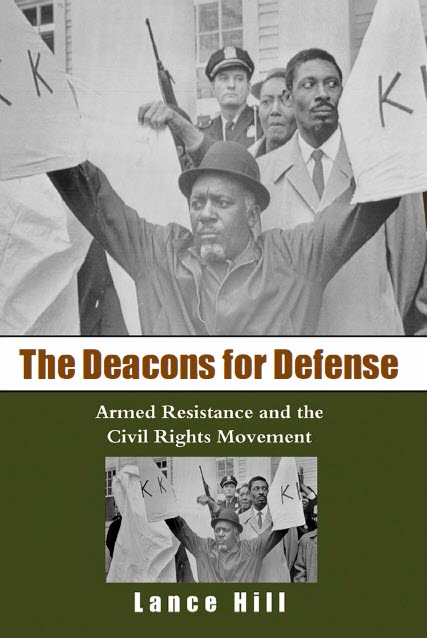
Mainstream organizations (SCLC, NAACP, national CORE) often stayed silent or distanced themselves because armed self-defense conflicted with the nonviolent image used to win Northern white support. Local CORE field staff, however, frequently welcomed the protection. Historian Lance Hill argues the Deacons were a working-class Southern alternative that made some local campaigns possible by deterring night riders when police would not.
UNC Press DDJ
Stokely Carmichael later cited them as an example of Black people realizing the law would not protect them. The group itself stayed focused on community defense rather than adopting explicit Black nationalist or Marxist programs. By 1967–1968 activity declined after the Voting Rights Act, increased Black electoral participation, FBI scrutiny of both the Klan and the Deacons, and the rise of the Black Panther Party, which absorbed much of the public attention around armed self-defense.
Wikipedia
Legacy
The Deacons demonstrated that organized, disciplined armed self-defense by Black Southerners could reduce Klan terror in specific locales and compel federal attention. They were not a mass guerrilla army and did not pursue the protracted “people’s war” strategy later associated with the Black Liberation Army. Their record sits in the lineage of earlier self-defense efforts (Robert F. Williams in Monroe, North Carolina) and later urban formations. Their story was long minimized in popular civil rights histories that emphasized nonviolence; recent work, including Hill’s book and documentaries, has recovered it.
YouTube
The spelling “Decons” in your query is the common shorthand or typo for this group. If you want a deeper dive on Bogalusa confrontations, their FBI files, comparison with the BLA, or specific chapters, say which angle.
Pop the document out from the upper right to read / expand / download.
 RBG Communiversity: Message 2 Da Grassroots
LikeLike