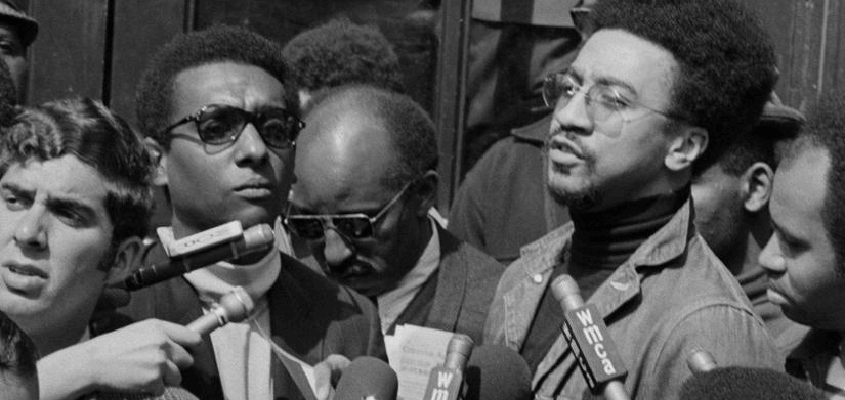
H. Rap Brown & Stokely Carmichael in Oakland (1968) and Black Power: The Politics of Liberation in America” by Kwame Ture (formerly known as Stokely Carmichael) and Charles V. Hamilton

Book Summary

“Black Power: The Politics of Liberation in America” by Kwame Ture (formerly known as Stokely Carmichael) and Charles V. Hamilton is a seminal text that articulates the philosophy and strategy of Black Power as a movement for social and political change in the United States. Published in 1967, the book examines the historical context of African American struggles for civil rights, critiques the limitations of the integrationist approach, and advocates for a more radical, self-determined strategy for achieving liberation. Ture and Hamilton emphasize the importance of collective identity, political organization, and grassroots activism in the fight against systemic racism and oppression.

The outline that follows captures the essence of “Black Power: The Politics of Liberation in America,” highlighting the authors’ exploration of the philosophy, strategies, and historical context of the Black Power movement. Ture and Hamilton provide a critical analysis of the limitations of previous civil rights strategies and advocate for a more radical and self-determined approach to achieving liberation for African Americans. The book remains a foundational text in understanding the dynamics of race, power, and social justice in the United States.

  • Introduction
  • Overview of the Black Power movement and its significance in American history
  • Definition of Black Power and its core principles
  • The authors’ motivations for writing the book and its intended impact
  • Historical Context
  • Examination of the civil rights movement and its achievements
  • Critique of integrationist strategies and their limitations
  • Historical roots of Black nationalism and the emergence of Black Power
  • The Philosophy of Black Power
  • Definition and exploration of the concept of Black Power
    • Emphasis on self-determination, pride, and identity
    • The importance of understanding race as a political category
  • Discussion of the psychological impact of oppression on African Americans
  • The role of culture and heritage in fostering a sense of community and empowerment
  • Political Organization and Strategy
  • Analysis of the need for organized political action among African Americans
  • The importance of grassroots movements and community organizing
  • Strategies for building political power, including voter registration and mobilization
  • The role of leadership in the Black Power movement
  • Critique of Liberalism
  • Examination of liberalism’s shortcomings in addressing the needs and aspirations of Black Americans
  • Arguments against reliance on white allies and the limitations of legislative reforms
  • The necessity for a more radical approach to achieve meaningful change
  • The Role of Violence and Self-Defense
  • Discussion of the relationship between the Black Power movement and the use of violence
  • The concept of self-defense against systemic violence and oppression
  • The authors’ stance on the legitimacy of armed struggle in the pursuit of liberation
  • Intersectionality and Solidarity
  • Exploration of the connections between race, class, and gender in the struggle for liberation
  • The need for solidarity among marginalized groups to achieve broader social justice
  • The importance of internationalism and global solidarity in the fight against imperialism and colonialism
  • The Future of Black Power
  • Vision for the future of the Black Power movement and its potential impact
  • The necessity for continued activism and political engagement
  • Call to action for younger generations to embrace the principles of Black Power
  • Conclusion
  • Summary of key arguments and insights presented in the book
  • Reflection on the ongoing relevance of Black Power in contemporary movements for racial and social justice
  • Final thoughts on the importance of self-determination and collective action

“Black Power: The Politics of Liberation in America” is a groundbreaking work that articulates the philosophy and strategies of the Black Power movement, which emerged as a response to the limitations of the civil rights movement. Published in 1967, the book offers profound insights into the political, social, and psychological dimensions of the struggle for African American liberation. Here’s a deeper exploration of the key themes, arguments, and historical significance of the book:

Key Themes Explored

  • Historical Context and Civil Rights Movement
  • The authors begin by situating the Black Power movement within the broader civil rights struggle, acknowledging the achievements made through nonviolent protests and legal reforms.
  • However, they critique the limitations of these integrationist strategies, arguing that they often failed to address the systemic nature of racism and the underlying economic inequalities faced by Black Americans.
  • Defining Black Power
  • Ture and Hamilton define Black Power as a call for self-determination, emphasizing the importance of Black identity, pride, and community solidarity.
  • They argue that understanding race as a political category is essential for mobilizing African Americans toward collective action and political empowerment.
  • Black Power is framed as a movement that encourages African Americans to recognize their own strength and potential, fostering a sense of agency and responsibility for their own liberation.
  • Political Organization and Grassroots Activism
  • The authors stress the need for organized political action, advocating for grassroots movements that empower local communities.
  • They outline strategies for building political power, including voter registration, community organizing, and the establishment of independent political entities to represent Black interests.
  • Ture and Hamilton highlight the role of leadership and the necessity of developing a new generation of leaders who are committed to the principles of Black Power.
  • Critique of Liberalism
  • The book critiques liberal approaches to civil rights, arguing that they often prioritize integration and assimilation over true liberation.
  • Ture and Hamilton contend that relying on white allies and legislative reforms is insufficient for achieving meaningful change, calling for a more radical rethinking of strategies to address systemic oppression.
  • They advocate for a fundamental restructuring of power dynamics, challenging the status quo that perpetuates racial injustice.
  • Violence and Self-Defense
  • The authors engage in a nuanced discussion about the use of violence in the pursuit of liberation. While they do not advocate for violence as the primary means of struggle, they emphasize the legitimacy of self-defense against systemic violence and the oppressive actions of the state.
  • They argue that, in the face of brutality, African Americans have the right to protect themselves and their communities.
  • Intersectionality and Solidarity
  • Ture and Hamilton explore the interconnectedness of race, class, and gender, arguing that the struggle for Black liberation must also address issues of economic inequality and gender oppression.
  • They call for solidarity among marginalized groups, emphasizing that true liberation requires the collective effort of all oppressed peoples.
  • The authors also stress the importance of internationalism, advocating for solidarity with anti-colonial movements around the world and recognizing the global dimensions of oppression.
  • Vision for the Future of Black Power
  • The book concludes with a forward-looking vision for the Black Power movement, urging continued activism and political engagement.
  • Ture and Hamilton encourage younger generations to embrace the principles of Black Power and to engage in the ongoing struggle for justice and equality.
  • They envision a future where African Americans can fully realize their potential and achieve true liberation through self-determination and collective action.

Significance and Impact

  • Foundational Text in Black Studies
  • “Black Power” has become a foundational text in Black Studies and political science, influencing generations of activists, scholars, and policymakers.
  • The book’s emphasis on self-determination, grassroots activism, and political organization has resonated with various social movements, including contemporary movements for racial justice, such as Black Lives Matter.
  • Legacy of the Black Power Movement
  • Ture and Hamilton’s work has contributed to a broader understanding of the Black Power movement as a critical response to systemic racism and oppression in the United States.
  • Their ideas continue to inform discussions about race, identity, and social justice, highlighting the importance of collective action in the pursuit of liberation.

Overall, “Black Power: The Politics of Liberation in America” is a powerful and impactful work that articulates a vision for Black liberation rooted in self-determination, political organization, and community empowerment. Kwame Ture and Charles V. Hamilton provide a compelling critique of existing systems of oppression and call for a radical rethinking of strategies to achieve meaningful change. The book remains a vital resource for understanding the dynamics of race and power in America and the ongoing struggle for justice and equality.

Black Power: The Politics of Liberation in America” by Kwame Ture (formerly known as Stokely Carmichael) and Charles V. Hamilton_eBook

Pop the documents out from the upper right to read / expand / download.

The Untold History of the United States, by Oliver Stone and Peter Kuznick_eBook and Video Education

Last Updated 05-02-2025

The companion to the Showtime documentary series, director Oliver Stone and historian Peter Kuznick challenge the prevailing orthodoxies of traditional history books in this thoroughly researched and rigorously analyzed look at the dark side of American history.

Book Summary

“The Untold History of the United States” by Oliver Stone and Peter Kuznick is a sweeping historical narrative that reexamines key events and themes in American history from a critical perspective. The book challenges conventional narratives surrounding U.S. history, particularly regarding war, imperialism, and the role of government. Stone and Kuznick argue that the United States has often acted contrary to its professed ideals of democracy and freedom, engaging in acts that undermine these principles both domestically and abroad. Through a combination of historical analysis, personal anecdotes, and a critical lens, the authors seek to illuminate the hidden aspects of American history that have shaped the country’s trajectory and its impact on the world.

The outline that follows captures the key themes and structure of “The Untold History of the United States” by Oliver Stone and Peter Kuznick. The book serves as a thought-provoking exploration of American history, urging readers to question established narratives and consider the broader implications of the United States’ actions both domestically and internationally. Through their critical approach, Stone and Kuznick aim to foster a deeper understanding of the complexities of U.S. history and its impact on the world.

I. Introduction

  • A. Purpose of the book
  • B. Overview of Oliver Stone and Peter Kuznick’s backgrounds
  • C. Importance of reevaluating U.S. history

II. Historical Context

  • A. The founding ideals of the United States
    • Declaration of Independence and Constitution
    • Contradictions in the founding principles
  • B. The role of imperialism in shaping U.S. policy
    • Early expansionism and Manifest Destiny
  • Impact on indigenous populations and neighboring countries

III. The American Century and World Wars

  • A. World War I and its aftermath
    • U.S. involvement and consequences
    • The Treaty of Versailles and its implications
  • B. World War II: A critical examination
    • The bombing of Hiroshima and Nagasaki
  • The rise of the military-industrial complex

IV. The Cold War Era

  • A. Origins of the Cold War
    • U.S.-Soviet relations post-World War II
    • The ideological battle between capitalism and communism
  • B. Key events and policies
    • The Korean War and Vietnam War
  • CIA interventions and covert operations
  • C. Dissent and resistance in the U.S.
    • The civil rights movement
  • Anti-war protests and counterculture

V. Contemporary Issues and U.S. Foreign Policy

  • A. Post-Cold War America
    • The implications of U.S. intervention in the Balkans
    • The War on Terror and its consequences
  • B. Critique of neoliberalism and globalization
    • Economic policies and their impact on inequality
  • The influence of corporations on government policy
  • C. Environmental challenges and imperialism
    • Climate change and its geopolitical implications
  • Resource wars and environmental degradation

VI. Reevaluating American Exceptionalism

  • A. The concept of American exceptionalism
    • Historical roots and implications
    • The reality of U.S. actions versus its ideals
  • B. Calls for a more honest historical narrative
    • Importance of recognizing past mistakes
  • Vision for a more equitable and just future

VII. Conclusion

  • A. Summary of key arguments and insights
  • B. The importance of learning from history
  • C. A call to action for informed citizenship and engagement

“The Untold History of the United States” by Oliver Stone and Peter Kuznick offers a provocative reexamination of key events and trends in American history, challenging conventional narratives and encouraging readers to consider the broader implications of the United States’ actions both domestically and internationally. Here’s a more detailed exploration of the book’s key themes, arguments, and insights:

Detailed Exploration of Key Themes

1. Historical Context and Founding Ideals

  • Contradictions of Founding Principles: Stone and Kuznick begin by discussing the founding ideals of the United States, such as liberty, equality, and democracy. However, they also highlight the contradictions inherent in these principles, particularly in relation to slavery, the treatment of indigenous peoples, and the exclusion of women and minorities from political rights.
  • Manifest Destiny and Imperialism: The authors examine early American expansionism, emphasizing how the ideology of Manifest Destiny justified the conquest of territories and the displacement of Native Americans. This sets the stage for a broader discussion of U.S. imperialism and its consequences.

2. The American Century and World Wars

  • World War I: The book analyzes the United States’ involvement in World War I, presenting it as a pivotal moment that shifted the country’s role on the global stage. The authors discuss the consequences of the war and how the Treaty of Versailles laid the groundwork for future conflicts.
  • World War II: Stone and Kuznick critically examine the U.S. actions during World War II, particularly the decision to drop atomic bombs on Hiroshima and Nagasaki. They argue that this act not only caused immense human suffering but also marked the beginning of a dangerous arms race and the establishment of the military-industrial complex.

3. The Cold War Era

  • Origins and Dynamics: The authors explore the origins of the Cold War, detailing the ideological battle between capitalism and communism that defined the post-World War II era. They analyze key events, such as the Berlin Blockade and the Cuban Missile Crisis, highlighting how U.S. foreign policy was often driven by a desire to contain communism at all costs.
  • Military Interventions: Stone and Kuznick provide an in-depth look at U.S. military interventions during the Cold War, including the Korean War and the Vietnam War. They argue that these conflicts were not only disastrous for the countries involved but also for American society, leading to widespread dissent and divisions at home.
  • Civil Rights and Anti-War Movements: The book emphasizes the role of dissenting voices during the Cold War, particularly the civil rights movement and anti-war protests. The authors highlight how these movements challenged the status quo and sought to hold the government accountable for its actions.

4. Contemporary Issues and Foreign Policy

  • Post-Cold War America: The authors discuss the implications of U.S. foreign policy in the post-Cold War era, including interventions in the Balkans and the Middle East. They argue that these actions often reflect a continuation of imperialist tendencies rather than a commitment to democracy and human rights.
  • War on Terror: The book critically examines the War on Terror following the September 11 attacks, arguing that it has led to significant civil liberties violations and has fueled further instability in the Middle East. Stone and Kuznick point to the long-term consequences of these policies, including the rise of extremist groups.
  • Neoliberalism and Globalization: The authors critique neoliberal economic policies and their impact on inequality in the United States and around the world. They explore how corporate interests have influenced government policy, often at the expense of ordinary citizens.
  • Environmental Concerns: The book addresses contemporary environmental challenges, emphasizing the interconnections between imperialism, resource exploitation, and climate change. Stone and Kuznick argue that U.S. foreign policy must be reevaluated in light of these urgent issues.

5. Reevaluating American Exceptionalism

  • Critique of Exceptionalism: Stone and Kuznick challenge the notion of American exceptionalism, arguing that the U.S. has often acted contrary to its stated ideals. They contend that recognizing these contradictions is essential for understanding the true nature of American history.
  • Importance of Historical Awareness: The authors stress the need for a more honest and nuanced understanding of U.S. history. They advocate for a critical reevaluation of the past to inform present and future actions, emphasizing the importance of learning from mistakes.

6. Conclusion and Call to Action

  • Summary of Insights: The book concludes by summarizing the key arguments presented throughout. Stone and Kuznick call for readers to engage with history critically, recognizing the complexities and contradictions that have shaped the United States.
  • Encouragement for Active Citizenship: The authors emphasize the importance of informed citizenship and active engagement in democratic processes. They argue that understanding history is crucial for advocating for social justice and holding those in power accountable.

Implications and Legacy

  • Revisiting Historical Narratives: “The Untold History of the United States” contributes to ongoing discussions about historical narratives and the importance of critically examining the past. It encourages readers to question established beliefs and consider alternative perspectives.
  • Influence on Public Discourse: The book has sparked conversations about American foreign policy, imperialism, and the need for social change, making it a significant resource for activists, educators, and students of history.
  • Vision for a Just Future: Through their critical analysis, Stone and Kuznick inspire readers to envision a more equitable and just society, one that learns from history to create a better future.

Conclusion

In summary, “The Untold History of the United States” by Oliver Stone and Peter Kuznick offers a thought-provoking and critical examination of American history. By challenging conventional narratives and highlighting the complexities of U.S. actions at home and abroad, the authors encourage readers to engage with history in a meaningful way. The book serves as a call to action for informed citizenship and the pursuit of social justice, emphasizing the importance of understanding the past to shape a better future.

The Untold History of the United States_eBook

Pop the documents out from the upper right to read / expand / download.

The Untold History of the United States_Video Education

27 Video Playlist

Learn more in RBG Communiversity Knowledge Media eLibrary

Malcolm X (Mwalimu Omarwali El-Hajj Malik El-Shabazz): By Any Means Necessary_Audio and Text

Minister Malcolm X (El-Hajj Malik El-Shabazz) delivered this speech in Detroit, MI. on Feb. 13, 1965, the day after his home in New York was firebombed. He confessed to being tired and worried, but nonetheless he still showed up in Detroit. Since many “people that present MX’s work” prefer to choice the MX or snippet of his words during his political, ideological and philosophical development that most closely suits their socio-political agenda, this speech most correctly provides insight into Malcolm’s ideas and Overstanding from his own mouth closest to his death.

Pop the document out from the upper right to read / expand / download.

 Minister Malcolm X “A Comprehensive Achieve” Folder