
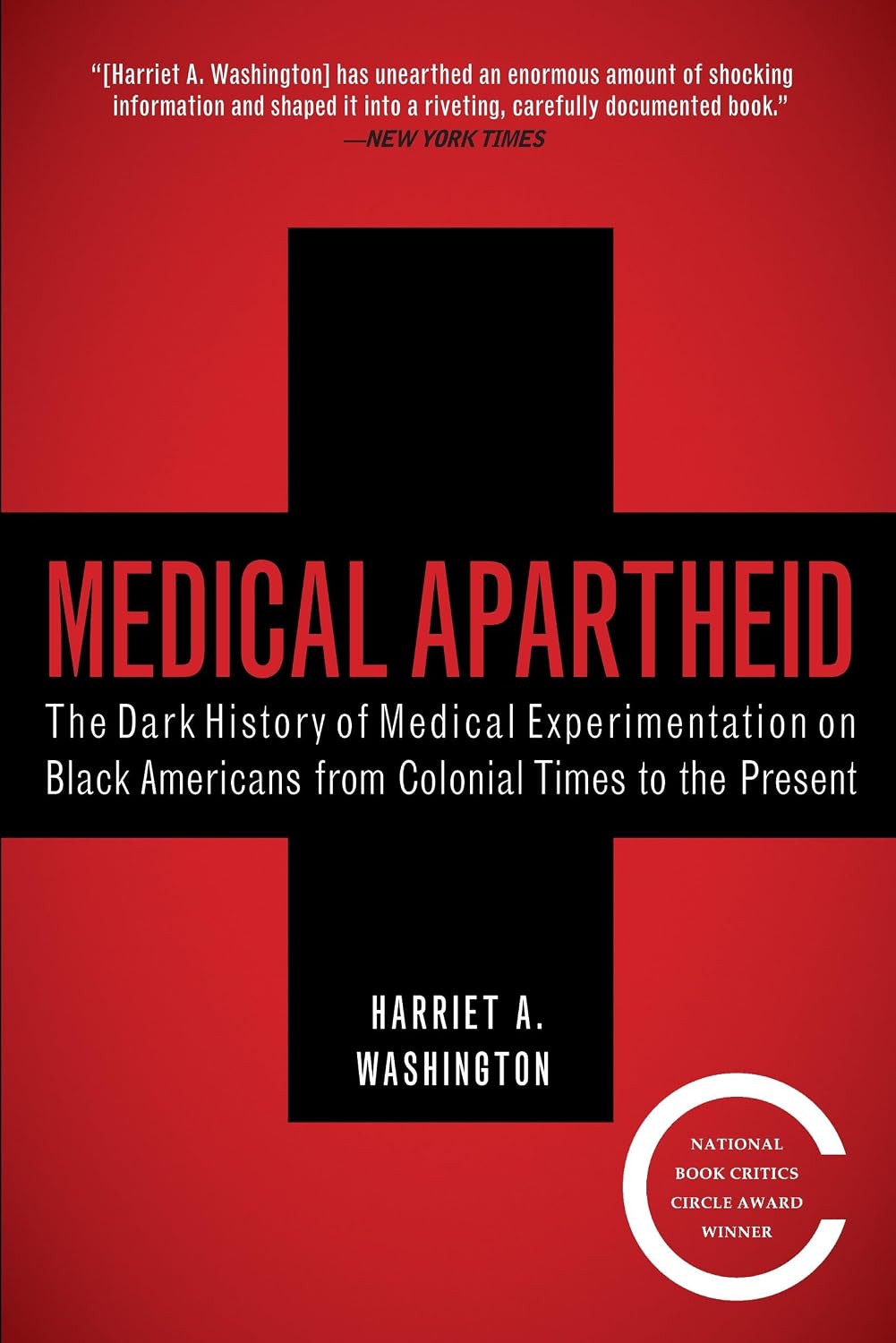
Book Summary
Medical Apartheid (2006) by Harriet A. Washington is a comprehensive historical account of unethical medical experimentation, exploitation, and mistreatment of Black Americans from the colonial era to the early 21st century. It argues that these practices formed a long-standing pattern rather than isolated events, helping explain persistent medical distrust and health disparities. The book won the 2007 National Book Critics Circle Award for Nonfiction and has been influential in discussions of medical ethics and race.
The book is organized into three main parts:
Part 1: A Troubling Tradition covers the 18th and 19th centuries through the early 20th century. It examines how enslaved people were used for medical experiments (often controlled by owners), the development of gynecological procedures by J. Marion Sims on enslaved women without anesthesia, the display of Black bodies as medical or public curiosities, and the widespread use of Black cadavers for dissection (via grave-robbing and disproportionate sourcing from poor or Black populations). It culminates in a detailed account of the Tuskegee Syphilis Study (1932–1972), in which the U.S. Public Health Service observed hundreds of poor Black men with syphilis without providing treatment (even after penicillin became available) to study the disease’s progression. Washington presents Tuskegee as emblematic of a broader continuum rather than a unique aberration.
Part 2: The Usual Subjects addresses 20th-century research involving vulnerable populations. Topics include eugenics-driven or coerced sterilizations (disproportionately affecting Black women), radiation and plutonium experiments, research conducted on prisoners, and studies involving children (including some examining genetics or behavior). The author emphasizes patterns in which Black subjects were frequently selected for higher-risk or non-therapeutic work, often without informed consent.
Part 3: Race, Technology, and Medicine discusses more contemporary issues, including the non-consensual harvesting and use of Henrietta Lacks’s cells (the HeLa line), disparities in clinical research participation and treatment, genetic research, and related technological or public-health applications. The book concludes with an epilogue that notes international parallels and offers recommendations for stronger informed-consent standards, ethics training, and research oversight.
Throughout, Washington draws on medical literature, archival records, and interviews to document specific cases and argue that acknowledging this history is necessary for repairing trust and improving ethical research participation. While the core episodes (such as Tuskegee and certain 19th-century surgical practices) are well-documented historical facts, some reviewers have debated the book’s framing, scale of claims, or specific details; it remains a widely cited and influential survey of the subject.
Pop the document out from the upper right to read / expand / download
Pop the document out from the upper right to read / expand / download


You must be logged in to post a comment.