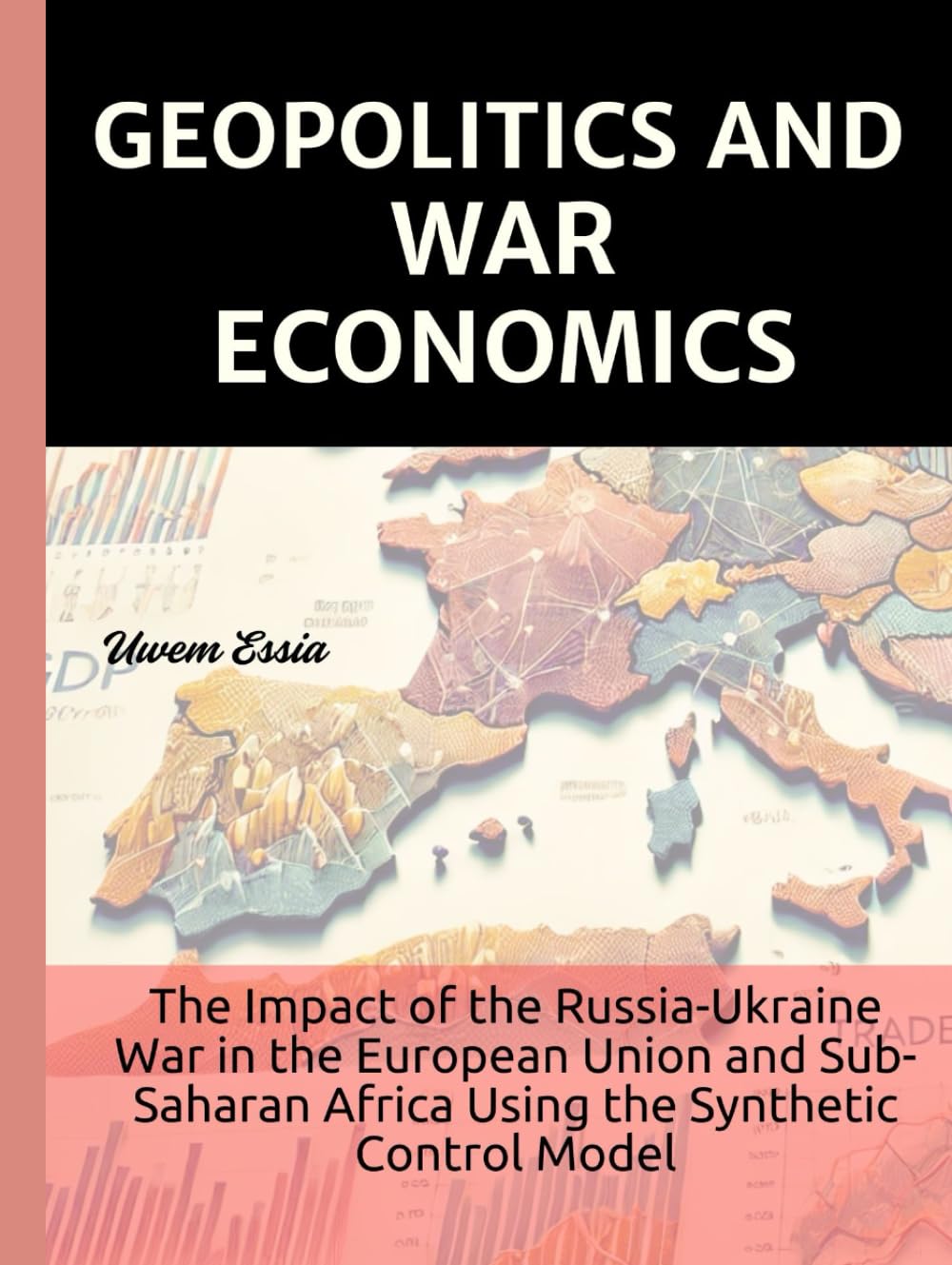
GEOPOLITICS AND WAR ECONOMICS: The Impact of the Russia-Ukraine War in the European Union and Sub-Saharan Africa Using the Synthetic Control Model, by Uwem Essia (Part of Peacebuilding and Development Series), with Solid Video Education

Part of: Peacebuilding and Development (21 books)
Book Summary

“GEOPOLITICS AND WAR ECONOMICS: The Impact of the Russia-Ukraine War in the European Union and Sub-Saharan Africa Using the “Synthetic Control Model” by Uwem Essia examines the far-reaching consequences of the Russia-Ukraine conflict on economic and geopolitical dynamics, particularly focusing on the European Union (EU) and Sub-Saharan Africa. Utilizing the Synthetic Control Model, the book provides a rigorous analysis of how the war has affected various economic indicators, trade relations, and geopolitical strategies in these regions. Essia delves into the interconnectedness of global economies and the implications of conflict on international relations, offering insights into how nations can navigate the complexities of a rapidly changing geopolitical landscape.

The outline that follows captures the essence of “GEOPOLITICS AND WAR ECONOMICS,” highlighting its focus on the economic and geopolitical impacts of the Russia-Ukraine conflict on the European Union and Sub-Saharan Africa. The book utilizes a rigorous methodological framework to provide valuable insights into the complexities of international relations and the challenges posed by geopolitical conflicts.

  • Introduction
  • Overview of the geopolitical context of the Russia-Ukraine war
  • Explanation of the significance of studying its impact on the EU and Sub-Saharan Africa
  • Introduction to the Synthetic Control Model as a methodological approach
  • Geopolitical Background
  • Historical context of Russia-Ukraine relations leading up to the conflict
  • Overview of key players in the EU and Sub-Saharan Africa
  • Analysis of the geopolitical implications of the war on global power dynamics
  • Methodology
  • Detailed explanation of the Synthetic Control Model
  • Justification for using this model to analyze economic impacts
  • Description of data sources and variables considered in the analysis
  • Impact on the European Union
  • Examination of economic repercussions within EU member states
    • Changes in trade patterns and energy dependency
    • Economic sanctions and their effects on EU economies
  • Analysis of political responses and shifts in foreign policy
    • Increased military expenditure and defense strategies
    • Solidarity measures among EU countries in response to the war
  • Impact on Sub-Saharan Africa
  • Assessment of the economic impact of the war on Sub-Saharan African nations
    • Disruptions in trade and supply chains, particularly in agriculture and energy
    • Inflationary pressures and food security concerns
  • Exploration of geopolitical ramifications for African nations
    • Shifts in alliances and foreign relations with Russia and Western nations
    • The role of African nations in global discussions about the conflict
  • Comparative Analysis
  • Comparison of the short-term and long-term effects of the war on the EU and Sub-Saharan Africa
  • Identification of common challenges faced by both regions due to the conflict
  • Insights into how different regions adapt to geopolitical shocks
  • Policy Implications
  • Recommendations for policymakers in the EU and Sub-Saharan Africa
    • Strategies for enhancing economic resilience and diversification
    • Approaches for strengthening regional cooperation and solidarity
  • Considerations for future geopolitical stability and security
  • Conclusion
  • Summary of key findings and insights from the analysis
  • Reflection on the broader implications of the Russia-Ukraine war for global geopolitics
  • Final thoughts on the importance of understanding the interconnectedness of global economies

“GEOPOLITICS AND WAR ECONOMICS” by Uwem Essia provides a comprehensive analysis of how the ongoing conflict between Russia and Ukraine has reshaped economic and geopolitical landscapes, particularly in the European Union (EU) and Sub-Saharan Africa. The book leverages the Synthetic Control Model, a quantitative method that allows for a robust evaluation of causal effects, to assess the war’s impact on various economic indicators and political dynamics in these regions.

Key Themes Explored

  • Geopolitical Context and Historical Background
  • The book begins by situating the Russia-Ukraine conflict within a broader historical context, examining prior relations between Russia and Ukraine and the factors leading to the escalation of tensions.
  • It explores how the war has redefined geopolitical alignments, with a focus on the shifting dynamics within the EU as member states respond to the crisis.
  • Methodological Framework
  • The Synthetic Control Model is central to Essia’s analysis, providing a framework for estimating what the economic outcomes would have been in the absence of the conflict. This method is particularly useful for assessing the impact of events that are not easily replicable or controlled for.
  • The author details the specific data sources used, including economic indicators and trade statistics, and explains how these variables were selected to construct the synthetic control groups for both the EU and Sub-Saharan Africa.
  • Economic Impact on the European Union
  • Essia investigates the immediate and long-term economic repercussions of the war on EU member states, such as:
    • Disruptions in trade flows, particularly concerning energy supplies, as many EU countries rely heavily on Russian gas and oil.
    • The imposition of sanctions on Russia, which had significant ripple effects on EU economies, including inflation and supply chain issues.
  • The analysis also covers shifts in the EU’s defense spending and military cooperation in response to perceived threats, as well as changes in foreign policy aimed at enhancing collective security.
  • Economic Impact on Sub-Saharan Africa
  • The book highlights the often-overlooked effects of the Russia-Ukraine conflict on Sub-Saharan African nations. Key points include:
    • The disruption of agricultural exports, particularly grains like wheat, which has exacerbated food insecurity in a region already vulnerable to climate change and economic instability.
    • Rising prices for essential goods, leading to inflationary pressures that affect the livelihoods of millions.
  • Essia discusses how Sub-Saharan African countries are navigating the geopolitical landscape, often balancing their relationships with both Western nations and Russia.
  • Comparative Analysis and Insights
  • The comparative analysis section synthesizes the findings from the two regions, identifying similarities and differences in how they are affected by the war.
  • Essia highlights common challenges, such as the need for economic diversification and resilience against external shocks, while also noting the distinct geopolitical strategies employed by the EU and Sub-Saharan Africa.
  • Policy Recommendations
  • The author provides actionable recommendations for policymakers in both regions, suggesting:
    • Economic diversification strategies to reduce dependency on single sources of energy or commodities.
    • Enhanced regional cooperation to build resilience against future geopolitical shocks.
    • The importance of engaging in diplomatic efforts to mitigate the conflict and its repercussions on global stability.

Conclusion and Broader Implications

  • Reflections on Global Interconnectedness
  • In the conclusion, Essia reflects on the interconnected nature of today’s global economy and how localized conflicts can have far-reaching implications.
  • He emphasizes that understanding the economic and geopolitical consequences of the Russia-Ukraine war is essential for anticipating future challenges and opportunities in international relations.
  • Future Geopolitical Stability
  • The book ends with a call for ongoing research and dialogue to address the complexities of global geopolitics, stressing the importance of adapting to changing dynamics in an increasingly multipolar world.

Overall, “GEOPOLITICS AND WAR ECONOMICS” offers a thorough and insightful examination of the ramifications of the Russia-Ukraine conflict, using a sophisticated methodological approach to shed light on the pressing economic and geopolitical issues facing the EU and Sub-Saharan Africa. By connecting the dots between conflict, economics, and international relations, Uwem Essia provides valuable perspectives that contribute to our understanding of contemporary global challenges.

“GEOPOLITICS AND WAR ECONOMICS: The Impact of the Russia-Ukraine War in the European Union and Sub-Saharan Africa Using the Synthetic Control Model” by Uwem Essia_eBook

Pop the document out from the upper right to read / expand / download

Geopolitics, Economics, War and Fall of U.S. Empire_Video Education 1

35 Video Playlist

Learn more in RBG Communiversity Knowledge Media eLibrary:

BLACK PSYCHOLOGY: Dr. Na’im Akbar and Dr. Asa Hilliard On Voices From the Village (Video Edu.) and Black Psychology eBook, Ed. by Dr. Reginald L. Jones (1972 Edition), with RBG| Black Psychology Education Player

Click for standalone poster.

Dr. Na’im Akbar and Dr. Asa Hilliard On Voices From the Village

“Voices From the Village” host, Chris Moore, conducts a 1995 interview with psychologists, Dr. Na’im Akbar (Florida State University) and the late Dr. Asa Hilliard (Georgia State University). The three discuss issues covering the legitimacy of Afrocentric scholarship, education, family value systems, and the American prison system. Broadcast Date: September 09, 1995 (3 Video Playlist)

Black Psychology eBook, Edited by Dr. Reginald L. Jones (1972 Edition)

Click for standalone poster.

BLACK PSYCHOLOGY: Thirty-six articles by black psychologists and behavioral scientists provide new data and provocative reinterpretations of the psychological literature on blacks. Emphasizing applied problems this volume presents both original and previously published papers which illuminate the range of activities that characterize this new area. BLACK PSYCHOLOGY offers insightful research commentaries and presents a variety of views on counseling, education, racism, and the applications of psychology in the community. It examines the issues associated with the psychological assessment of blacks, especially the problem of effectively testing blacks in school settings. The role of the black psychologist as a professional in the community is considered. (From the back cover.)

Pop the document out from the upper right to read / expand / download.

RBG| Black Psychology Education Player

32 Video Playlist

Learn more in RBG Communiversity Knowledge Media eLibrary:

Black (African-Centered) Psychology Folder

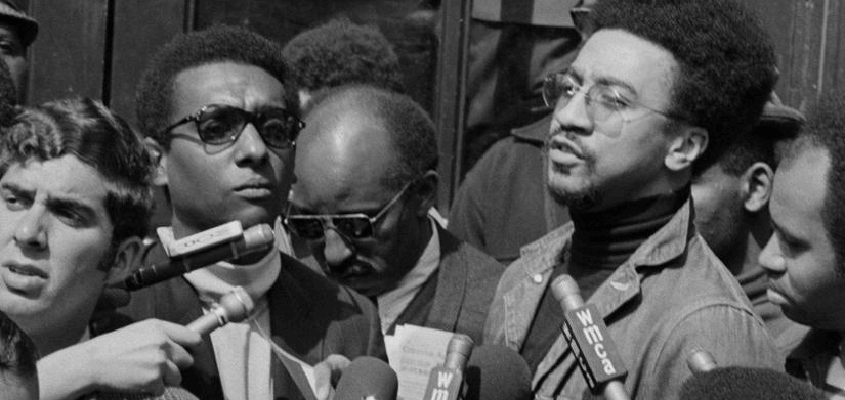
H. Rap Brown & Stokely Carmichael in Oakland (1968) and Black Power: The Politics of Liberation in America” by Kwame Ture (formerly known as Stokely Carmichael) and Charles V. Hamilton

Book Summary

“Black Power: The Politics of Liberation in America” by Kwame Ture (formerly known as Stokely Carmichael) and Charles V. Hamilton is a seminal text that articulates the philosophy and strategy of Black Power as a movement for social and political change in the United States. Published in 1967, the book examines the historical context of African American struggles for civil rights, critiques the limitations of the integrationist approach, and advocates for a more radical, self-determined strategy for achieving liberation. Ture and Hamilton emphasize the importance of collective identity, political organization, and grassroots activism in the fight against systemic racism and oppression.

The outline that follows captures the essence of “Black Power: The Politics of Liberation in America,” highlighting the authors’ exploration of the philosophy, strategies, and historical context of the Black Power movement. Ture and Hamilton provide a critical analysis of the limitations of previous civil rights strategies and advocate for a more radical and self-determined approach to achieving liberation for African Americans. The book remains a foundational text in understanding the dynamics of race, power, and social justice in the United States.

  • Introduction
  • Overview of the Black Power movement and its significance in American history
  • Definition of Black Power and its core principles
  • The authors’ motivations for writing the book and its intended impact
  • Historical Context
  • Examination of the civil rights movement and its achievements
  • Critique of integrationist strategies and their limitations
  • Historical roots of Black nationalism and the emergence of Black Power
  • The Philosophy of Black Power
  • Definition and exploration of the concept of Black Power
    • Emphasis on self-determination, pride, and identity
    • The importance of understanding race as a political category
  • Discussion of the psychological impact of oppression on African Americans
  • The role of culture and heritage in fostering a sense of community and empowerment
  • Political Organization and Strategy
  • Analysis of the need for organized political action among African Americans
  • The importance of grassroots movements and community organizing
  • Strategies for building political power, including voter registration and mobilization
  • The role of leadership in the Black Power movement
  • Critique of Liberalism
  • Examination of liberalism’s shortcomings in addressing the needs and aspirations of Black Americans
  • Arguments against reliance on white allies and the limitations of legislative reforms
  • The necessity for a more radical approach to achieve meaningful change
  • The Role of Violence and Self-Defense
  • Discussion of the relationship between the Black Power movement and the use of violence
  • The concept of self-defense against systemic violence and oppression
  • The authors’ stance on the legitimacy of armed struggle in the pursuit of liberation
  • Intersectionality and Solidarity
  • Exploration of the connections between race, class, and gender in the struggle for liberation
  • The need for solidarity among marginalized groups to achieve broader social justice
  • The importance of internationalism and global solidarity in the fight against imperialism and colonialism
  • The Future of Black Power
  • Vision for the future of the Black Power movement and its potential impact
  • The necessity for continued activism and political engagement
  • Call to action for younger generations to embrace the principles of Black Power
  • Conclusion
  • Summary of key arguments and insights presented in the book
  • Reflection on the ongoing relevance of Black Power in contemporary movements for racial and social justice
  • Final thoughts on the importance of self-determination and collective action

“Black Power: The Politics of Liberation in America” is a groundbreaking work that articulates the philosophy and strategies of the Black Power movement, which emerged as a response to the limitations of the civil rights movement. Published in 1967, the book offers profound insights into the political, social, and psychological dimensions of the struggle for African American liberation. Here’s a deeper exploration of the key themes, arguments, and historical significance of the book:

Key Themes Explored

  • Historical Context and Civil Rights Movement
  • The authors begin by situating the Black Power movement within the broader civil rights struggle, acknowledging the achievements made through nonviolent protests and legal reforms.
  • However, they critique the limitations of these integrationist strategies, arguing that they often failed to address the systemic nature of racism and the underlying economic inequalities faced by Black Americans.
  • Defining Black Power
  • Ture and Hamilton define Black Power as a call for self-determination, emphasizing the importance of Black identity, pride, and community solidarity.
  • They argue that understanding race as a political category is essential for mobilizing African Americans toward collective action and political empowerment.
  • Black Power is framed as a movement that encourages African Americans to recognize their own strength and potential, fostering a sense of agency and responsibility for their own liberation.
  • Political Organization and Grassroots Activism
  • The authors stress the need for organized political action, advocating for grassroots movements that empower local communities.
  • They outline strategies for building political power, including voter registration, community organizing, and the establishment of independent political entities to represent Black interests.
  • Ture and Hamilton highlight the role of leadership and the necessity of developing a new generation of leaders who are committed to the principles of Black Power.
  • Critique of Liberalism
  • The book critiques liberal approaches to civil rights, arguing that they often prioritize integration and assimilation over true liberation.
  • Ture and Hamilton contend that relying on white allies and legislative reforms is insufficient for achieving meaningful change, calling for a more radical rethinking of strategies to address systemic oppression.
  • They advocate for a fundamental restructuring of power dynamics, challenging the status quo that perpetuates racial injustice.
  • Violence and Self-Defense
  • The authors engage in a nuanced discussion about the use of violence in the pursuit of liberation. While they do not advocate for violence as the primary means of struggle, they emphasize the legitimacy of self-defense against systemic violence and the oppressive actions of the state.
  • They argue that, in the face of brutality, African Americans have the right to protect themselves and their communities.
  • Intersectionality and Solidarity
  • Ture and Hamilton explore the interconnectedness of race, class, and gender, arguing that the struggle for Black liberation must also address issues of economic inequality and gender oppression.
  • They call for solidarity among marginalized groups, emphasizing that true liberation requires the collective effort of all oppressed peoples.
  • The authors also stress the importance of internationalism, advocating for solidarity with anti-colonial movements around the world and recognizing the global dimensions of oppression.
  • Vision for the Future of Black Power
  • The book concludes with a forward-looking vision for the Black Power movement, urging continued activism and political engagement.
  • Ture and Hamilton encourage younger generations to embrace the principles of Black Power and to engage in the ongoing struggle for justice and equality.
  • They envision a future where African Americans can fully realize their potential and achieve true liberation through self-determination and collective action.

Significance and Impact

  • Foundational Text in Black Studies
  • “Black Power” has become a foundational text in Black Studies and political science, influencing generations of activists, scholars, and policymakers.
  • The book’s emphasis on self-determination, grassroots activism, and political organization has resonated with various social movements, including contemporary movements for racial justice, such as Black Lives Matter.
  • Legacy of the Black Power Movement
  • Ture and Hamilton’s work has contributed to a broader understanding of the Black Power movement as a critical response to systemic racism and oppression in the United States.
  • Their ideas continue to inform discussions about race, identity, and social justice, highlighting the importance of collective action in the pursuit of liberation.

Overall, “Black Power: The Politics of Liberation in America” is a powerful and impactful work that articulates a vision for Black liberation rooted in self-determination, political organization, and community empowerment. Kwame Ture and Charles V. Hamilton provide a compelling critique of existing systems of oppression and call for a radical rethinking of strategies to achieve meaningful change. The book remains a vital resource for understanding the dynamics of race and power in America and the ongoing struggle for justice and equality.

Black Power: The Politics of Liberation in America” by Kwame Ture (formerly known as Stokely Carmichael) and Charles V. Hamilton_eBook

Pop the documents out from the upper right to read / expand / download.

Pedagogy of the Oppressed, Paulo Freire_eBook and Video Education_ Understanding Paulo Freire’s “Pedagogy of the Oppressed” Dr. Masood

Last Updated 03-20-2025

PEDAGOGY OF THE OPPRESSED

Book Summary

“Pedagogy of the Oppressed” by Paulo Freire is a foundational text in critical pedagogy that critiques traditional education models and advocates for a more liberating approach to teaching and learning. Freire argues that conventional education often reinforces oppression by treating students as passive recipients of knowledge rather than active participants in their own learning. He emphasizes the importance of dialogue, critical thinking, and consciousness-raising to empower learners and challenge oppressive systems. Freire presents a vision of education as a practice of freedom, where educators and students collaboratively engage in the process of learning, fostering critical awareness and social change.

Outline:

  • Introduction
    • Context of education as a tool for liberation or oppression
    • Importance of critical pedagogy
  • Oppression and Education
    • Definition of oppression in society
    • Traditional education as a “banking model” that deposits information into passive students
  • Dialogical Method
    • Emphasis on dialogue as a means of communication and understanding
    • The role of critical reflection in education
  • Consciousness-Raising
    • Importance of developing critical consciousness (conscientização)
    • Awareness of social, political, and economic contradictions
  • The Role of the Educator
    • Shift from authority figure to co-learner and facilitator
    • Encouraging collaboration and mutual respect in the classroom
  • Liberation through Education
    • Education as a practice of freedom rather than domination
    • Fostering a sense of agency and empowerment among learners
  • Cultural Context
    • Recognition of the unique cultural backgrounds of students
    • Importance of culturally relevant pedagogy
  • Conclusion
    • Call for a transformative approach to education
    • Vision of a just society achieved through critical education and social action

“Pedagogy of the Oppressed” is a profound work that not only critiques existing educational practices but also offers a transformative vision for how education can be a means of liberation. Here’s a deeper exploration of its main themes and concepts:

Key Themes and Concepts:

  1. Banking Model of Education:
    • Freire critiques the traditional “banking” model of education, where teachers deposit information into students, who are expected to memorize and regurgitate it. This model promotes passive learning and maintains the status quo, rather than fostering critical thinking or creativity. Freire advocates for a more dynamic and interactive approach to education.
  2. Dialogue and Communication:
    • Central to Freire’s philosophy is the idea of dialogue. He argues that education should be a collaborative process where both teachers and students engage in meaningful conversations. Dialogue enables learners to express their thoughts, question assumptions, and develop critical perspectives.
  3. Conscientização (Critical Consciousness):
    • Freire introduces the concept of conscientização, which refers to the process of developing a critical awareness of one’s social reality. This consciousness allows individuals to recognize oppressive structures in society and empowers them to take action against these injustices. Education, in this sense, becomes a means of awakening this critical consciousness.
  4. Praxis:
    • Freire emphasizes the importance of praxis, which is the combination of reflection and action. He argues that true education must lead to transformative action, allowing learners to apply their critical thinking to real-world problems. This cycle of reflection and action helps individuals challenge and change their oppressive conditions.
  5. Cultural Context and Relevance:
    • Freire stresses the significance of acknowledging the cultural backgrounds of learners. Education should be relevant to students’ lived experiences and cultural contexts, promoting a sense of identity and belonging. This relevance enhances engagement and learning outcomes.
  6. Role of the Educator:
    • Freire redefines the role of educators, suggesting they should act as facilitators and co-learners rather than authoritative figures. Educators are encouraged to create an environment of mutual respect and collaboration, where students feel empowered to share their ideas and challenge existing norms.
  7. Oppression and Liberation:
    • The book explores the dynamics of oppression, emphasizing that true liberation requires a collective struggle against oppressive systems. Freire argues that the oppressed must play an active role in their emancipation, fostering solidarity and collective action.
  8. Social Justice and Transformation:
    • Freire’s pedagogy is rooted in a commitment to social justice. He envisions education as a means to transform society by equipping individuals with the tools to challenge inequality and advocate for change. This transformative potential is a key aspect of his educational philosophy.

Conclusion:

“Pedagogy of the Oppressed” remains a seminal text that has influenced educators, activists, and scholars worldwide. Freire’s insights into the relationship between education and social justice have sparked movements for reform in educational practices. His call for a participatory and liberating approach to education continues to resonate, encouraging individuals to seek not only knowledge but also the power to enact meaningful change in their lives and communities. The book serves as both a critique of traditional educational systems and a powerful manifesto for a more equitable and just approach to teaching and learning.

Pedagogy of the Oppressed, Paulo Freire_eBook

Pop the documents out from the upper right to read / expand / download.

Understanding Paulo Freire’s “Pedagogy of the Oppressed” Dr. Masood

Mini-Lectures_Pedagogy of the Oppressed_ Dr Jason Campbell

PEDAGOGY OF THE OPPRESSED2