STAY RBG ROOTED_First Message to the Negroes of the World From Atlanta Prison | Marcus Garvey, Feb 10, 1925

STAY RBG ROOTED

First Message to the Negroes of the World From Atlanta Prison | Marcus Garvey, Feb 10, 1925

Fellow Men of the Negro Race, Greeting: I am delighted to inform you, that your humble servant is as happy in suffering for you and our cause as is possible under the circumstances of being viciously outraged by a group of plotters who have connived to do their worst to humiliate you through me, in the fight for real emancipation and African Redemption. I do trust that you have given no credence to the vicious lies of white and enemy newspapers and those who have spoken in reference to my surrender. The liars plotted in every way to make it appear that I was not willing to surrender to the court. My attorney advised me that no mandate would have been handed down for ten or fourteen days, and is the custom of the courts, and that would have given me time to keep speaking engagements I had in Detroit, Cincinnati and Cleveland. I hadn’t left the city of ten hours when the liars flashed the news that I was a fugitive. That was good news to circulate all over the world to demoralize the millions of Negroes in America, Africa, Asia, the West Indies and Central America, but the idiots ought to know by now that they can’t fool all the Negroes at the same time. I do not want at this time to write anything that would make it difficult for you to meet the opposition of the enemy without my assistance. Suffice to it say that the history of the outrage shall form a splendid chapter in the history of Africa redeemed, when black men will no longer be under the heels of others, but have a civilization and country of their own. The whole affair is a disgrace, and the whole black world knows it. We shall not forget. Our day may be fifty, a hundred or two hundred years ahead, but let us watch, work and pray, for the civilization of injustice is bound to crumble and bring destruction down upon the heads of the unjust. The idiots thought that they could humiliate me personally, but in that they are mistaken. The minutes of suffering are counted, and when God and Africa come back and measure out retribution these minutes may multiply by thousands for the sinners. Our Arab and Riffian friends will be ever vigilant, as the rest of Africa and ourselves shall be. Be assured that I planted well the seed of Negro or black nationalism which cannot be destroyed even by the foul play that has been meted out to me. Continue to pray for me and I shall ever be true to my trust. I want you, the black peoples of the world, to know that W.E.B. Du Bois and that vicious Negro-hating organization known as the Association for the Advancement of “Colored” People are the greatest enemies the black people have in the world. I have so much to do in…Download full pdf https://www.slideshare.net/rbgstreetscholar1/first-message-to-the-negroes-of-the-world-from-atlanta-prison-marcus-garvey-feb-10-1925-24737375 Download
A Father of Black Nationalism: The Influence of Marcus Garvey| “Look for me in the Whirlwind”

“Look for me in the Whirlwind”


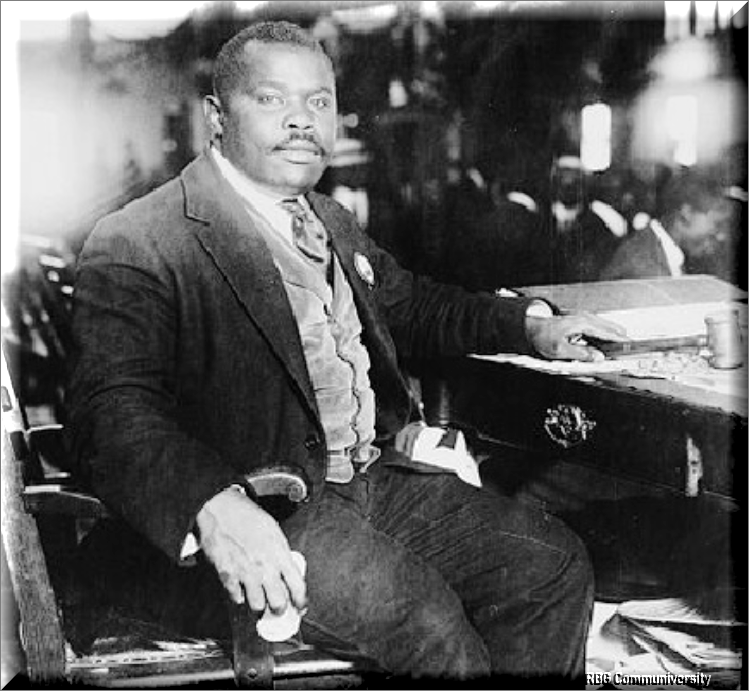
Black Nationalism originated in the 1850’s. While the origins of the movement are most commonly associated with Marcus Garvey’s Universal Negro Improvement Association (UNIA) of the 1920s, Garvey was preceded and influenced by Martin Delany, Henry Sylvestre-Williams, Dr. Robert Love and Edward Wilmot Blyden. Even though the future of Africa is seen as being central to Black Nationalist ambitions, some adherents to Black Nationalism are intent on the eventual creation of a separate black nation by Africans in American.
Born in St. Ann’s Bay, Jamaica, on August 17, 1887, Marcus Garvey was the youngest of 11 children. Garvey moved to Kingston at the age of 14, found work in a printshop, and became acquainted with the abysmal living conditions of the laboring class. He quickly involved himself in social reform, participating in the first Printers’ Union strike in Jamaica in 1907 and in setting up the newspaper The Watchman. Leaving the island to earn money to finance his projects, he visited Central and South America, amassing evidence that black people everywhere were victims of discrimination. He visited the Panama Canal Zone and saw the conditions under which the West Indians lived and worked. He went to Ecuador, Nicaragua, Honduras, Colombia and Venezuala. Everywhere, blacks were experiencing great hardships.

Garvey returned to Jamaica distressed at the situation in Central America, and appealed to Jamaica’s colonial government to help improve the plight of West Indian workers in Central America. His appeal fell on deaf ears. Garvey also began to lay the groundwork of the Universal Negro Improvement Association, to which he was to devote his life. Undaunted by lack of enthusiasm for his plans, Garvey left for England in 1912 in search of additional financial backing. While there, he met a Sudanese-Egyptian journalist, Duse Mohammed Ali. While working for Ali’s publication African Times and Oriental Review, Garvey began to study the history of Africa, particularly, the exploitation of black peoples by colonial powers. He read Booker T. Washington’s Up From Slavery, which advocated black self-help.

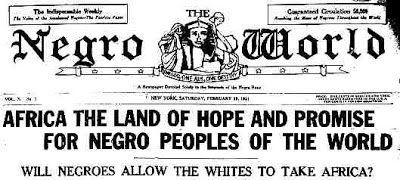
In 1914 Garvey organized the Universal Negro Improvement Association and its coordinating body, the African Communities League. In 1920 the organization held its first convention in New York. The convention opened with a parade down Harlem’s Lenox Avenue. That evening, before a crowd of 25,000, Garvey outlined his plan to build an African nation-state. In New York City his ideas attracted popular support, and thousands enrolled in the UNIA. He began publishing the newspaper The Negro World and toured the United States preaching Black Nationalism to popular audiences. His efforts were successful, and soon, the association boasted over 1,100 branches in more than 40 countries. Most of these branches were located in the United States, which had become the UNIA’s base of operations. There were, however, offices in several Caribbean countries, Cuba having the most. Branches also existed in places such as Panama, Costa Rica, Ecuador, Venezuela, Ghana, Sierra Leone, Liberia, Namibia and South Africa. He also launched some ambitious business ventures, notably the Black Star Shipping Line.

http://library.mysticseaport.org/initiative/PageImage.cfm?BibID=38817
Stock Certificate, 1920 – Black Star Line, Inc.

rbg mgp22

Financial betrayal by trusted aides and a host of legal entanglements (based on charges that he had used the U.S. mail to defraud prospective investors) eventually led to Garvey’s imprisonment in Atlanta Federal Penitentiary for a five-year term. In 1927 his half-served sentence was commuted, and he was deported to Jamaica by order of President Calvin Coolidge.Garvey then turned his energies to Jamaican politics, campaigning on a platform of self-government, minimum wage laws, and land and judicial reform. He was soundly defeated at the polls, however, because most of his followers did not have the necessary voting qualifications.In 1935 Garvey left for England where, in near obscurity, he died on June 10, 1940, in a cottage in West Kensington.

In the years following the organization’s first convention, the UNIA began to decline in popularity. With the Black Star Line in serious financial difficulties, Garvey promoted two new business organizations – the African Communities League and the Negro Factories Corporation. He also tried to salvage his colonization scheme by sending a delegation to appeal to the League of Nations for transfer to the UNIA of the African colonies taken from Germany during World War I.

Click for full size standalone poster read.