Proper Knowledge Yields Freedom: A Civil Debate

Hi QueenPearl9, thank you for the intelligent and passionate comment…and most of all thank you for the respectful tone you bring with your different views.
Despite the wealth of solid information presented within this page / course alone, I am nonetheless not surprised that you would not agree. But if you are a true seeker of truth..read the full page and follow some links before you take your final position on this most important topic-“THEY ARE STILL OUR SLAVES”.
The long answer as to why I / we hold the position that we (Afrikans in Amerikkka) are still slaves is articulated in the body of the communiversity’s content quite well I think …Ones cumulative overstanding of content once they spend some quality time with it. …For those who choice to pick one lil thing out of the larger picture and formulate an ill informed position, here’s the short version of my / our reasoning:
The idea that we are still slaves is not merely my observation, it is a well documented fact, researched , written about and struggled against by many more learned then I for the past 100 + years ( post emancipation proclamation). All one needs to do is look at the data / indices of “well being” during chattel slavery times and compare that data to our condition as a group today. All qualifiers included, the masses of our people are even worst off today then during those times:
The Civil Rights & Black Liberation Movements & COINTELPRO
Its just that your “education” does not view these things as of primary importance, RBG does.

That is much of what we do here ( look at problems & offer solutions). But people see what they want to see and read what they want to read, more frequently the not, with a total disregard for all facts. Everything I put on the more than 20 websites / 5,000 learning objects-media assets is well documented by the most respected and scholarly sources (Afrikan scholars, educators, psychologists, historians, sociologists, personologists, elders, ancestors etc…are our professors).
Fact, selfish, ignorant, and greedy are not Afrikan peoples original way.You can’t explain away how these things keep us enslaved by saying “other people manifest them also”, because every other people has a history that is quite different from ours.
In order to come up with the correct perspective you have to put what a people does in its proper historical context.
No one else has our history…
DeAfrikanized culturally ie., we lost our land, language, religion, God, folkways, mores and power of our own being.
DeHumanized in the eyes of the rest of the world as to justify the slavery, rape and murder.
Inferiortized in our own mind and spirit to hate our self.
These things took place systematically over the course of hundreds of years…And you dare say that we should be bunched in with others who have these flaws–WRONG.
Please see and read:
The Civil Rights & Black Liberation Movements & COINTELPRO

If you study the school closely you will find that selfish, ignorant, and greedy are the ways of a European conceptual framework, ie. white supremacy. There is no separation between the past, present and future–based on our history we can’t afford to do what others do, epically our former slavemaster.

Let’s look at an illustration:
Afrikan & Traditional Afrikan American Family Worldview / Definitional System / Conceptual Framework vs The European’s:
>we, ours, us–not I, me, mines
>cooperative–not competitive
>groupness–not oneness
>collective–individualistic
>spiritual-not material
>man & women were a complimentary dualism–not man vs women
>man in harmony with nature–not man vs nature
>peace and harmony–not greed and violence…and I can go on and on.

The main take home point here QueenPearl9 is we are other than our self / controlled by anothers way–that’s a slave sista and the primary cause of 99.9% of current intergroup problems.

For example, if you look at the characteristics to the right in the above illustration you don’t know if I’m talking about the dope game on the corner or corporate America–because the dope game as it is played out in every ghetto/barrio is merely a microcosm of the corporate American ethos.

Finally, on a most fundamental level, any people who don’t provide food, clothing, shelter, energy, education, protection and recreation (to name a few) for themselves are slaves to those who provide those things to them. Just look at all that I present in this school. Ask yourself, are the things RBG Street Scholar presents important for Black people to think about ? Once you answer yes, ask yourself this, are they taught in such a comprehensive manner in K-12, college, graduate school?–hell no. Why
BECAUSE WE ARE STILL SLAVES and slaves must stay ignorant of self. In other words its still against the rules for us to educate ourselves. Its still against the rules for us to defend, define and development in our own image and interest. And the main culprits today in this self-alienation process is us; because of the brainwashing of white supremacy/racism (socio-structural, institutional and interpersonal)…I mean, it use to be against the white man’s law and rule for us to read and many were lashed and kill for trying to do so; but today you have to lash us to make us read. This is called intropression: When the opressed are subject to oppression as long as us we internalize the oppressor and thus do to ourselves what the oppressor once did..THAT IS A SLAVE.
Take the time to read the Willie Lynch Letter above with close attention. Its saying the same thing.

Hotep

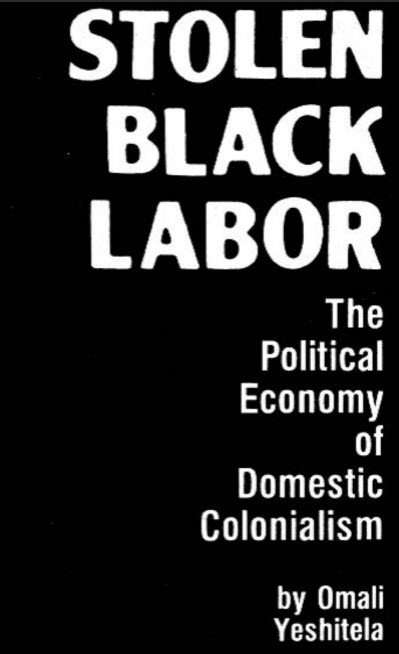
#OmaliTaughtMe_White nation-state Built on the Pedestal of Slavery and Colonialism, with Stolen Black Labor: The Political Economy of Domestic Colonialism by Omali Yeshitela

Last Updated 02-08-2025

Solidarity

Pop the document out from the upper right to read / expand / download.

Book Summary

“Stolen Black Labor: The Political Economy of Domestic Colonialism” by Omali Yeshitela is a critical examination of the exploitation and oppression of Black people in the United States, framed within the context of domestic colonialism. Yeshitela argues that the systemic exploitation of Black labor has been integral to the economic development of the U.S., drawing parallels between historical and contemporary forms of oppression. The book explores the intersections of race, class, and economic structures, elucidating how the legacy of slavery has persisted through various forms of exploitation in modern society. Yeshitela presents a call for political awareness and activism to address these enduring injustices.

Outline

  • Introduction
    • Overview of the book’s themes and objectives
    • Definition of domestic colonialism and its relevance to the Black experience in America
    • Explanation of the connection between historical exploitation and contemporary issues
  • Chapter 1: Historical Context of Black Labor
    • Examination of the origins of Black labor in the U.S. and the legacy of slavery
    • Discussion of the economic foundations of slavery and its role in capitalist development
    • Analysis of the transition from slavery to sharecropping and other forms of labor exploitation
  • Chapter 2: The Concept of Domestic Colonialism
    • Definition and exploration of domestic colonialism as a framework for understanding Black oppression
    • Discussion of how domestic colonialism manifests in economic, social, and political structures
    • Analysis of the impact of colonialism on Black communities and their development
  • Chapter 3: The Political Economy of Exploitation
    • Exploration of the economic systems that perpetuate the exploitation of Black labor
    • Discussion of how capitalism relies on the devaluation of Black labor and the maintenance of poverty
    • Examination of the roles of institutions, policies, and practices that sustain economic disparities
  • Chapter 4: Resistance and Resilience
    • Overview of historical and contemporary forms of resistance by Black communities
    • Discussion of movements for civil rights, economic justice, and self-determination
    • Analysis of the significance of community organizing and grassroots activism in challenging oppression
  • Chapter 5: The Role of the State and Policy
    • Examination of the state’s role in perpetuating or addressing the exploitation of Black labor
    • Discussion of policies that have historically marginalized Black communities, such as redlining and mass incarceration
    • Analysis of contemporary policy proposals aimed at addressing economic injustices
  • Chapter 6: Towards a New Political Economy
    • Exploration of the possibilities for economic empowerment and liberation for Black communities
    • Discussion of alternative economic models that prioritize equity and justice
    • Call for a reimagining of economic relationships and structures to dismantle systemic oppression
  • Conclusion
    • Summary of key arguments and insights presented in the book
    • Reflection on the importance of understanding the historical context of Black labor to inform contemporary activism
    • Call to action for collective struggle against domestic colonialism and the pursuit of justice

Importance of the Book

“Stolen Black Labor: The Political Economy of Domestic Colonialism” is a vital contribution to the discourse on race, labor, and economic exploitation in the U.S. Omali Yeshitela’s analysis provides a framework for understanding the enduring impacts of colonialism and the systemic nature of oppression faced by Black people. The book serves not only as a historical examination but also as a call for political engagement and activism aimed at achieving true liberation and justice for Black communities.

“Stolen Black Labor” is a thought-provoking and deeply analytical work that addresses the systemic exploitation of Black labor throughout American history and its implications for contemporary society. Here’s a more detailed exploration of the key themes, arguments, and significance of the book:

Key Themes Explored

  1. Domestic Colonialism as a Framework
    • Yeshitela introduces the concept of “domestic colonialism,” framing the systemic oppression of Black people as a form of colonialism occurring within the borders of the United States. He argues that this framework helps to understand the ongoing exploitation and marginalization of Black communities.
    • The book distinguishes domestic colonialism from traditional colonialism by emphasizing that it occurs in the context of a nation where the colonized population is subjected to both economic exploitation and cultural suppression.
  2. Historical Continuity of Labor Exploitation
    • The author traces the history of Black labor from the era of slavery to present-day economic conditions. He illustrates how the legacy of slavery has morphed but continues to influence the treatment and exploitation of Black workers.
    • Yeshitela discusses the transition from slavery to sharecropping, highlighting how economic structures were designed to keep Black people in cycles of poverty and dependency, effectively replicating aspects of the exploitative system of slavery.
  3. Capitalism and Racial Exploitation
    • The book argues that capitalism in the U.S. is built on the exploitation of Black labor, relying on a system that devalues Black contributions and perpetuates economic disparities.
    • Yeshitela examines how economic policies and practices have historically favored white populations while systematically disenfranchising Black communities, leading to significant wealth gaps and social inequalities.
  4. Resistance and Agency
    • Yeshitela emphasizes the importance of resistance within Black communities, documenting historical and contemporary efforts to combat exploitation. He highlights various movements for civil rights, labor rights, and economic justice as expressions of resilience and agency.
    • The author discusses the significance of grassroots organizing and community activism as pivotal elements in the struggle against domestic colonialism, illustrating how collective action has historically led to meaningful change.
  5. The Role of the State
    • The book critically examines the role of government institutions in perpetuating systemic oppression. Yeshitela discusses policies that have marginalized Black communities, including redlining, discriminatory labor practices, and mass incarceration.
    • He argues that the state often acts in ways that reinforce existing power structures rather than addressing the needs and rights of marginalized populations.
  6. Vision for the Future
    • Yeshitela calls for a reimagining of economic systems that prioritize equity and justice for Black communities. He advocates for economic models that empower rather than exploit, emphasizing the need for systemic change.
    • The book encourages readers to envision a future where Black labor is valued, and communities have the agency to determine their economic destinies.

Significance of the Book

  • Critical Analysis of Systemic Issues
    • “Stolen Black Labor” provides a critical lens through which to view the intersection of race and economics in American society. Yeshitela’s analysis challenges readers to confront uncomfortable truths about the historical and ongoing exploitation of Black labor.
    • The book serves as an essential resource for scholars, activists, and anyone interested in understanding the complexities of race, class, and economic systems in the U.S.
  • Call to Action
    • Yeshitela’s work is not only an academic examination but also a passionate call to action for social and economic justice. He emphasizes the need for continued activism and awareness to dismantle systemic oppression and advocate for the rights of Black people.
    • By linking historical struggles to contemporary issues, the book urges readers to engage in the ongoing fight for equity and justice.
  • Broader Implications for Social Justice
    • The concepts explored in “Stolen Black Labor” resonate beyond the specific context of Black labor, inviting discussions about the treatment of marginalized groups within various economic systems. Yeshitela’s arguments contribute to broader conversations about human rights, social justice, and the necessity of addressing economic inequalities.

Conclusion

“Stolen Black Labor” is a powerful and necessary examination of the historical and contemporary exploitation of Black labor in America. Through the lens of domestic colonialism, the book highlights the enduring legacies of slavery, the systemic nature of oppression, and the vital importance of resistance and activism. Yeshitela’s work serves as both a historical account and a rallying cry for justice, making it an essential addition to the discourse on race, economics, and social change.

“Stolen Black Labor: The Political Economy of Domestic Colonialism” by Omali Yeshitela _eBook

Pop the documents out from the upper right to read / expand / download.

Learn more in RBG Communiversity Knowledge Media eLibrary: