

Pop the document out from the upper right to read / expand / download.
Pop the document out from the upper right to read / expand / download.
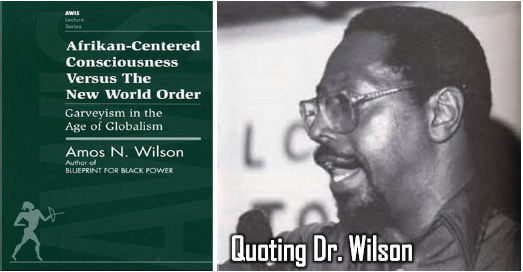
…”One of the things that we must recognize is that our oppressor represents death; our oppressor is deadly. One of the things that impressed me most when I went to graduate school and rally had my first real contact with the white educational establishment was that these people are dead. There’s death around them somewhere, which is the reason they are deadly as a people, why every advance of knowledge for them is advancement in the knowledge of destruction. Every advancement in knowledge is an advancement in the ability to kill and destroy the earth, kill and destroy nature, kill and destroy others, rape and rob the earth of its wealth, people and life forms, so much so that now they are having great difficulty even reproducing themselves. At the very center of their lives is death and destruction. We cannot imitate a people who are our oppressors”…
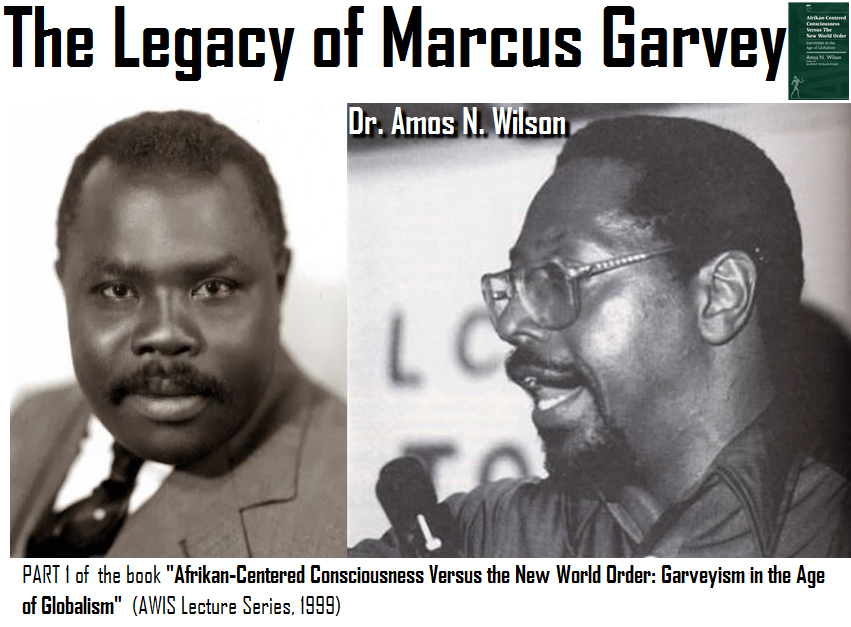
Book Review from Greg D | Dr. Wilson’s delineation of the TRUE Black Nationalist is, alone, worth the price of the book. He frames his argument by first capturing the essence of the life and work of the great Afrikan redeemer, Hon. Marcus Garvey. Subsequently, he provides the global Afrikan community a “checklist” with which to judge the TRUE Afrikan Nationalist. One is thus armed with the tools to differentiate between Black leaders and “leading” Blacks.
Pop the document out from the upper right to read / expand / download.
Learn more in RBG Communiversity eLibrary:
Updated 07-12-2024

Text and links that comprise this part are from
J.B. Bird, First published June 5, 2005
J. M. Stotesburg’s Original Photograph of the Black Seminole Scouts on their Mounts, ca. 1890
The only known nineteenth-century photograph of the “A Rebel Negroe Arm’d and on his guard,” 1794 engraving by Francesco Bartolozzi, after a watercolor by J.G. Stedman, for Stedman’s Narrative of a Five Years Expedition Against the Revolted Negroes of Surinam (1796). This hand-tinted version comes from Bakker et al’s Geschiedenis Van Suriname.

Following are Extracts from “Rebellion: John Horse and the Black Seminoles, First Black Rebels to Beat American Slavery”
Look at any standard reference to American slave revolts, and chances are, the Black Seminole rebellion of 1835-1838 does not even make the list. Below are some representative sites that can be readily checked online:
Chronology on the history of slavery and racism from The Holt House.
Major revolts and escapes from AFRO-Americ@: Black resistance.
Slave Revolts and Rebellions from The African-American: A Journey from Slavery to Freedom.
The oversight is not unexpected given that the major scholars of American slavery, on whose writings the reference works rely, have likewise missed or misinterpreted the Black Seminole slave rebellion. According to John Hope Franklin, Eugene Genovese, Stanley Elkins, Kenneth Stampp, Herbert Aptheker, and the many scholars who have relied on these giants in the field, the Black Seminole maroons joined Indians to fight the U.S. Army in 1835, and some of the maroons may have been runaway slaves. But the scholars seem unaware that nearly 400 plantation slaves, and possibly hundreds more, joined the maroons and Indians in an uprising of slaves that had no peer for size and longevity in American history…
From: http://www.johnhorse.com/
————————————————————–

To take part in the African revolution it is not to write a revolutionary song; you must fashion the revolution with the people. And if you fashion it with the people, the songs will come by themselves, and of themselves. … In order to achieve real action, you must yourself be a living part of Africa and of her thought; you must be an element of that popular energy which is entirely called for the freeing, the progress, and the happiness of Africa. There is no place outside that fight for the artist or for the intellectual who is not himself concerned with and completely at one with the people in the great battle of Africa and of all suffering humanity.
Sekou Touré
—————————————————————–
From: https://sourcebooks.web.fordham.edu/africa/africasbook.asp
Very few, if any, African-Americans accepted their status as slaves. Most, if not all, slaveowneres were completely aware of this and, in general, they lived in fear of the African-Americans under the control. Not only did slaveowners expect slaves to run away, letters and diaries give strong evidence that slaveowners (and even non-slaveowners) in the south believed that rebellion was imminent. They had lived with this fear since 1792 when the Haitian Revolution proved unambiguously that slaves were ready to revolt and could do so with a passion that was awe-inspiring. Added to this mix was the fiery rhetoric of abolitionists, both black and white. The most frightening, to the slaveowners, of these abolitionists was Henry Highland Garnet who had escaped from slavery at the age of ten. In 1843 he called for a slave strike and suggested that it escalate to a slave revolt. By this point, the south had been rocked by three slave revolts which had struck fear to the very hearts of slaveowners.

Gabriel Prosser

The first major slave revolt in the south was led by a twenty-four year old slave named Gabriel Prosser. All of the major slave revolts in the south were led by people like Prosser, who were deeply Christian and were fired by religious indignation against slavery. Prosser was the first. In 1800, he began to lay plans to take the city of Richmond, Virginia, by force. He planned to invade Richmond, attack the armory, and arm his rebel slaves. By August of 1800, he had thousands of slaves enlisted and had stored up an armory of weapons, including guns. He was betrayed by two followers and, on the day of his revolt, with over a thousand followers ready to attack Richmond, the bridges into Richmod had been destroyed in a flood. The state militia attacked him the next day and he and his followers were hanged.

Althought Prosser’s revolt ended in defeat, it terrified slaveowners throughout the south. Prosser had come very close to taking Richmond. If he had not been betrayed and if the bridges had not washed out, it is almost certain that he would have successfully taken the city of Richmond with his slave followers. Prosser’s revolt was the closest America came to a revolution on the same scale as that in Haiti.
Further study link out: Gabriel’s Conspiracy 1799 – 1800
http://www.pbs.org/wgbh/aia/part3/3p1576.html
Denmark Vesey

Denmark Vesey, like so many other African-American leaders of the nineteenth century, came from the “upper class” of slaves: the engineers and craftspeople who were given a high degree of independence and self-actualization, as opposed to field workers or house slaves. He purchased his own freedom and settled down as a carpenter in Charleseton, South Carolina.
Despite the surface placidity of his free life, he was fired with anger over slavery and the situation of black slaves. Throughout his entire free existence, he planned and thought about freeing his fellow slaves. He was so full of anger that companions say that he could not even remain in the presence of a European-American.
Like Prosser, Vesey was also deeply inspired by Christianity, in particular, the Old Testament. An integral aspect of slave and free Christianity was its emphasis on the delivery of the “children of Israel” from bondage in Egypt. This story was perhaps the most powerful religious and cultural influence on the world view of nineteenth century Americans. While most historians stress the passive nature of the Israelite deliverance, that deliverance was also yoked to the Israelite invasion of the land of Canaan. While this invasion was barely successful, the Old Testament books telling the history of the Canaan occupation and its aftermath are ruthlessly violent and present a warrior god with no mercy towards non-Israelites. All evidence we have suggests that slaves understood that these two events were connected and that deliverance along Israelite lines would be bought with human blood. Vesey, who went around quoting biblical texts to slaves to inspire them to revolt, particularly loved to quote Yahweh’s instructions to Joshua when he demands that Joshua kill every occupant of the cities of Canaan including women and children.
His task, as he saw it, was to incite slaves into revolt. In 1821, that focus changed dramatically and he began to organize his own revolt. He organized a working group of lieutenants that included Gullah Jack, a sorceror considered absolutely invulnerable and Peter Poyas who was one of the great military and organizational geniuses of the early nineteenth century. Poyas organized the revolt into separate cells under individual leaders. Only the leaders knew the plot; if any slave betrayed the plot, they would only betray their one cell. By 1822, almost all the slaves in the plantations surrounding Charleston had joined the revolt. His and Poyas’s plan was brilliantly simple. The rebels would all station themselves at the doors of European-Americans and, late at night, a group of rebels would start a major fire. When the men came out their doors, the rebels would kill them with axes, picks, or guns. They would then enter the houses and kill all the occupants. Like Prosser’s revolt, they almost won. They were betrayed early in the game, but the cell structure prevented officials from finding out the plot itself or identifying any of the leaders. It was only the day before that a slave, who knew the entire plot, betrayed Vesey. He and his co-leaders were hung, but only one confessed.
Learn more: House Slaves Betrayed Denmark Vesey By Unveiling Revolt Plot 190 Years
Nat Turner

Vesey’s revolt was immensely frightening to southern slave-owners. Not only was it difficult to crack the plot, despite the fact that thousands of slaves were involved, but the sheer thoroughness of the violence planned chilled the hearts of even the most confident slaveowners. That so many slaves would be willing to exterminate any and all European Americans regardless of gender or age brought home the depth of feeling, anger, and resistance that surrounded slaveowners all day long.
Neither Prosser’s nor Vesey’s rebellions actually succeeded; despite their fear, European-Americans believed that, in the end, God had protected them. This would all change, however, when a man that slaves simply called Prophet, Nat Turner, led a short revolt in which God did not protect slaveowners.
Turner, like Vesey, was from the “upper class” of slaves. He had grown up deeply hating slavery; his mother, an African, so hated slavery that she tried to kill him when he was born in 1800 to prevent him from living the life of a slave. He, too, was religious, in fact, far more than Vesey and Prosser. His Christianity was a religion of visions and mystical experience. By the time he was a young man, Turner had become unofficially the major religious leader in Southampton county in Virginia. Unlike Vesey, Turner’s Christianity emphasized not the Israelite deliverance, but the latter days of Christ in Jerusalem and the apocalyptic promise of a New Jerusalem. His rhetoric had a place as well as a spiritual meaning: Jerusalem, Virginia, which lay nearby.
All his disciples, seven of them, were fired by anger and religious passion. One, Will, had been so abused by his master that he was covered with scars. On the appointed night on Sunday, they left Turner’s house and entered the house of his master where, with only one hatchet and one broadax between them, they executed all the members, including two teens, with the exception of an infant. They then moved from house to house throughout the night and executed every European-American they could find with the exception of a white family that owned no slaves; Will chopped up his master and his wife so passionately that Turner called him “Will the Executioner.” As they went from house to house they gathered slaves and weapons. By Monday, they were approaching Jerusalem but were turned back by a regiment of European-Americans. Turner dug a cave and went into hiding, but when troops arrived they scoured the countryside and executed slaves by the hundred. Turner, however, was never caught for over two months; during all this time, Virginians were seized with panic. Hundred fled the county and many left the state for good. Turner, however, was eventually captured and hung. This was the last straw; from this point onwards, no slaveowner lived comfortably with slavery now that they understood the anger, the resistance, and the vengeance that boiled beneath the burden of slavery.
Learn more in RBG Communiversity eLibrary: NAT TURNER
The Amistad


Although no significant revolt occurred after Turner’s death, his passion and success escalated the conflict between the states over slavery. One more revolt, however, would seriously change the entire issue of slavery and slave revolts: the Amistad incident. In general, Amistad is overlooked by historians in favor of the more lurid and more deliberate revolts in Haiti and in the southern United States. The Amistad incident, however, dramatically changed the European-American idea of slave revolt and the moral constitution of slave revolts.
The year is 1839. Slave traffic is officially illegal in every country in the world. Despite this, a Cuban boat, the Amistad, is still trading in human lives kidnapped from Western Africa. On this trip, however, led by a powerful African, who speaks no European language, named Cinque, leads a revolt against the crew and kills everyone except the captain and first mate. He demands that the Africans be returned to Africa but instead the captain sails to New York. Claiming that the Africans are Cuban slaves rather than Africans, the United States put them on trial for murder and revolt. The result, however, was a stunning reversal in European ideas of slave revolts. Defended by no less than John Quincy Adams, the court declares the African revolutionaries to be justified in their murder of the crew. For the first time, Americans applied to slaves the same right to revolt as they believed they had. The southern revolts, from Haiti to Turner, suddenly shifted in the minds of many Americans as representing what they really were: freedom wars. To many Americans, it was becoming increasingly evident that the answer to slavery in the south had to be violent.
https://famous-trials.com/amistad
A Collection of true stories of brave African-American rebels who fought against slavery, from Cinque, who pleaded his case before the Supreme Court, to Nat Turner, who led one of the greatest revolts in history.
Pop the document out from the upper right to read / expand / download.


Long Fahiym RBG Ali

 RBG Communiversity: Message 2 Da Grassroots
You must be logged in to post a comment.