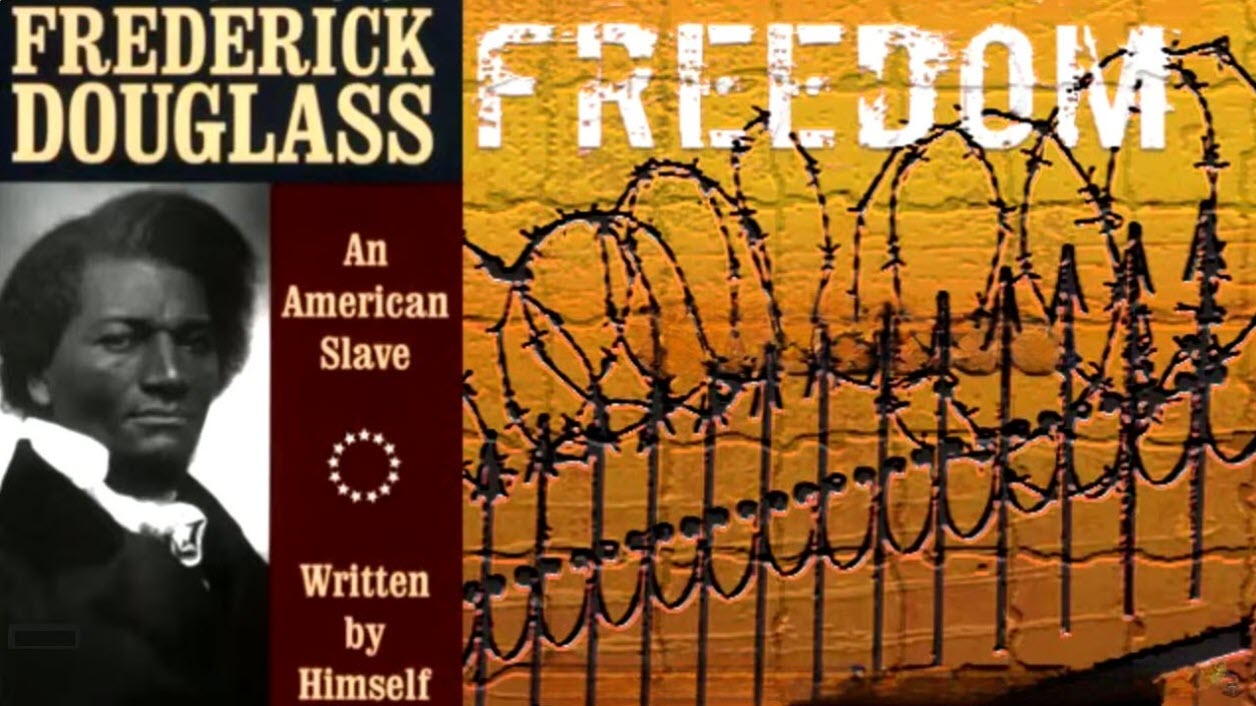
Narrative of the Life of Frederick Douglass_eBook and Audiobook and Supplemental_Frederick Douglass Escapes Slavery | Full Documentary | Biography

Updated June 15, 2024
Pop the document out from the upper right to read / expand / download.

Supplemental_Frederick Douglass Escapes Slavery | Full Documentary | Biography

Related Post/Lesson:

Frederick Douglass_What to the Slave Is The Fourth Of July, Read by Ossie Davis

Learn more in RBG Communiversity Knowledge Media eLibrary|

Frederick Douglass_A Former Slave Folder

Post-Traumatic Slave Syndrome: Prof. James Smalls and Dr. Joy DeGruy Leary_Video Education and eBook

Click for full size poster.

Post Slavery Traumatic Syndrome Discussion

Pop the document out from the upper right to read / expand / download.

Post-Traumatic Slave Syndrome: America’s Legacy of Enduring Injury and Healing by Joy DeGruy Leary, Ph.D., Foreword by Randall Robinson

Definition: Post traumatic slave syndrome is defined by DeGruy (2005) as “a condition that exists when a population has experienced multigenerational trauma resulting from centuries of slavery and continues to experience oppression and institutionalized racism today.

Buy the book here: Post Traumatic Slave Syndrome, Revised Edition: America’s Legacy of Enduring Injury and Healing Hardcover

Book Summary

“Post-Traumatic Slave Syndrome” explores the enduring psychological and social effects of slavery on African Americans and their descendants. Dr. Joy DeGruy Leary presents a framework for understanding how the traumas of slavery have been passed down through generations, affecting identity, behavior, and community dynamics. The book combines historical analysis, psychological insights, and personal narratives to illustrate the long-term impacts of systemic racism and the necessity for healing.

The outline that follows encapsulates the core themes and structure of Dr. Joy DeGruy Leary’s influential work, highlighting the profound effects of slavery on contemporary African American life and the path toward healing and understanding.

  1. Introduction
    • Definition of Post-Traumatic Slave Syndrome (PTSS)
    • Overview of historical context and relevance
  2. Historical Background
    • The legacy of slavery in America
    • The transition from slavery to Jim Crow laws
    • Impact of systemic racism on African American communities
  3. Understanding Trauma
    • Definition of trauma and its psychological impacts
    • The concept of generational trauma
    • How trauma manifests in behavior and community dynamics
  4. Symptoms of PTSS
    • Identifying behavioral patterns linked to PTSS
    • Emotional and psychological symptoms
    • Social implications and community effects
  5. Coping Mechanisms and Responses
    • Historical and cultural coping strategies
    • The role of faith, community, and resilience
  6. Healing and Recovery
    • Importance of acknowledging and addressing trauma
    • Strategies for healing within individuals and communities
    • Role of education and awareness in healing
  7. Conclusion
    • The significance of understanding PTSS for future generations
    • Call to action for societal change and healing
  8. Appendices
    • Resources for further reading and support
    • Discussion questions for reflection and dialogue

Here’s a more detailed exploration of the themes and significant aspects covered in “Post-Traumatic Slave Syndrome”

PTSS delves deeper into the psychological impacts of slavery, emphasizing how the trauma experienced by enslaved individuals has shaped the behaviors and experiences of their descendants.

Key Themes and Concepts

  1. Post-Traumatic Slave Syndrome (PTSS):
    • Dr. DeGruy defines PTSS as a condition that results from the multi-generational trauma experienced by African Americans due to slavery and systemic racism. She likens it to PTSD but emphasizes its unique historical context.
  2. Historical Context:
    • The book outlines the brutal realities of slavery, including dehumanization, violence, and family separation. It traces how these experiences have a lasting impact that extends beyond the individual to their descendants.
  3. Generational Trauma:
    • DeGruy discusses how the psychological scars of slavery and racism can be transmitted through generations. This includes the internalization of negative stereotypes and the perpetuation of trauma-related behaviors within families and communities.
  4. Behavioral Patterns:
    • The author identifies specific behaviors and attitudes that may arise from PTSS, such as distrust, anger, and feelings of hopelessness. She explains how these behaviors can hinder personal and community development.
  5. Coping Mechanisms:
    • Throughout the book, Dr. DeGruy highlights various coping mechanisms that African Americans have developed in response to their trauma. These include cultural resilience, community support, and spiritual practices that play a crucial role in healing.
  6. The Role of Education:
    • Education is emphasized as a vital tool for understanding the historical and psychological impacts of slavery. DeGruy advocates for incorporating this knowledge into educational curricula to foster awareness and healing.
  7. Healing and Empowerment:
    • The book concludes with a focus on healing strategies, emphasizing the importance of acknowledging trauma, seeking therapy, and engaging in community healing processes. DeGruy encourages readers to confront the legacy of slavery and work towards empowerment and resilience.

Importance of the Work

Dr. Joy DeGruy Leary’s work is significant for several reasons:

  • Awareness: It raises awareness about the lasting impacts of slavery and racism, encouraging dialogue about these issues in contemporary society.
  • Cultural Understanding: The book fosters a deeper understanding of African American experiences and the psychological ramifications of historical trauma.
  • Call to Action: It serves as a call to action for individuals, communities, and institutions to recognize the effects of PTSS and to support healing initiatives.

Overall, “Post-Traumatic Slave Syndrome” is a critical examination of the intersection of history, psychology, and social justice, making it a valuable resource for anyone interested in understanding the complexities of race and trauma in America.

Pop the document out from the upper right to read / expand / download.
Dr. Joy DeGruy Post Traumatic Slave Syndrome Video Edu.

WE ARE AT WAR_ REVOLUTION IS THE ONLY SOLUTION _ Empire and the Prison Industrial Complex Expose’ (Video Edu.) Empire Files with Journalist Abby Martin,with The Prison-industrial Complex, the Global Economy. (Eve Goldberg, Linda Evans)

we are at war

Icebreaker Video_Dead Prez – Thats War

The Rise of History’s Biggest Empire

TELESUR ABBY MARTIN ON U'S; EMPIRE

Abby Martin debuts teleSUR’s The Empire Files exploring the U.S. Empire, its rise to world hegemony and its impact on people and the planet.

America Has The biggest prison system in the world

TELESUR ABBY MARTIN ON U'S; PRISONS

Empire Files With Abby Martin: Enter the Biggest Prison System in History

Pop the documents out from the upper right to read / expand / download.

The Prison-industrial Complex, the Global Economy. (Eve Goldberg, Linda Evans)

Book Summary

“The Prison-Industrial Complex: The Global Economy” by Eve Goldberg and Linda Evans examines the intersection of the prison system with economic and social structures on a global scale. The authors argue that the expansion of the prison system is closely linked to neoliberal economic policies, systemic racism, and social inequality. The book critiques the growing influence of the prison-industrial complex, which they define as the relationship between government, private industry, and the prison system, highlighting how this relationship perpetuates cycles of poverty, marginalization, and oppression. Through analysis of case studies, policy discussions, and historical context, Goldberg and Evans call for awareness and action against the injustices perpetuated by this complex.

The outline that follows encapsulates the essence of “The Prison-Industrial Complex: The Global Economy,” highlighting Eve Goldberg and Linda Evans’ critical examination of the prison system’s relationship with global economic structures. The book serves as an important resource for understanding the complexities of mass incarceration and its implications for social justice, urging readers to consider the broader societal impacts of the prison-industrial complex and to engage in efforts for meaningful reform.

  • Introduction
    • Overview of the prison-industrial complex and its significance in contemporary society
    • Explanation of the book’s objectives and key themes
  • Part I: Historical Context of the Prison System
    • Evolution of Prisons
      • Overview of the history of prisons in the United States and globally
      • Discussion of how societal attitudes toward punishment and rehabilitation have changed over time
    • Impact of Neoliberalism
      • Examination of the rise of neoliberal economic policies and their influence on the prison system
      • Analysis of the relationship between economic downturns and increased incarceration rates
  • Part II: The Prison-Industrial Complex
    • Definition and Components
      • Explanation of what constitutes the prison-industrial complex
      • Overview of the roles of government, private corporations, and non-profit organizations in the prison system
    • Economic Incentives
      • Discussion of the financial motivations behind the expansion of the prison system
      • Examination of how private prisons and prison labor create profit opportunities for companies
  • Part III: Social and Racial Implications
    • Systemic Racism and Incarceration
      • Analysis of the disproportionate impact of incarceration on communities of color
      • Examination of how systemic racism is embedded in the criminal justice system
    • Impact on Families and Communities
      • Discussion of the social consequences of mass incarceration on families and communities
      • Exploration of the long-term effects of incarceration on individuals and their reintegration into society
  • Part IV: Global Perspectives on Incarceration
    • Comparative Analysis
      • Examination of incarceration rates and prison systems in different countries
      • Discussion of how globalization affects the prison-industrial complex and human rights
    • Case Studies
      • Presentation of specific case studies that illustrate the global implications of the prison system
      • Analysis of international movements against mass incarceration and prison exploitation
  • Part V: Alternatives and Solutions
    • Reforming the Prison System
      • Discussion of potential reforms to address the injustices of the prison-industrial complex
      • Exploration of restorative justice and alternative sentencing as viable solutions
    • Activism and Advocacy
      • Overview of grassroots movements and organizations working to combat the prison-industrial complex
      • Call to action for readers to engage in advocacy and support efforts for reform
  • Conclusion
    • Summary of key arguments and insights presented in the book
    • Reflection on the necessity of dismantling the prison-industrial complex for social justice
    • Final thoughts on the role of individuals and communities in advocating for change

“The Prison-Industrial Complex: The Global Economy” offers a critical exploration of how the prison system intersects with broader economic, social, and political structures. The authors argue that the expansion of the prison system is not merely a response to crime but is deeply rooted in systemic inequalities, neoliberal economic policies, and the profit motives of both government and private entities. Below is a more in-depth examination of the key themes, arguments, and significance of the book:

Key Themes Explored

  • Prison-Industrial Complex
    • The authors define the prison-industrial complex as the interlocking relationships between government agencies, private corporations, and non-profit organizations that benefit from the expansion of the prison system. This complex creates a cycle of incarceration that prioritizes profit over rehabilitation and social justice.
    • They highlight how the privatization of prisons has led to a profit-driven model that incentivizes incarceration rather than addressing the root causes of crime.
  • Historical Context and Neoliberalism
    • Goldberg and Evans provide a historical overview of the prison system, detailing its evolution from a focus on rehabilitation to a punitive model that reflects neoliberal economic policies. They argue that the shift toward neoliberalism in the late 20th century has exacerbated social inequalities and led to increased incarceration rates, particularly among marginalized communities.
    • The authors connect economic downturns and social unrest to the rise in incarceration, suggesting that prisons are often used as a tool to control dissent and manage social problems.
  • Systemic Racism and Social Inequality
    • A significant focus of the book is the impact of systemic racism on incarceration rates. The authors argue that the criminal justice system disproportionately affects people of color due to discriminatory policies, biased policing practices, and socio-economic disparities.
    • They emphasize that mass incarceration serves as a mechanism of social control, perpetuating cycles of poverty and marginalization in communities of color.
  • Global Perspectives on Incarceration
    • The book provides a comparative analysis of prison systems worldwide, exploring how globalization affects incarceration rates and human rights. Goldberg and Evans examine the similarities and differences in how countries address crime and punishment, shedding light on the global implications of the prison-industrial complex.
    • They discuss international movements advocating for prison reform and the abolition of mass incarceration, highlighting the importance of solidarity in the fight for justice.

Contributions and Insights

  • Critical Analysis of Economic Incentives
    • The authors delve into the economic motivations behind the prison-industrial complex, illustrating how private corporations profit from prison labor and the construction of new facilities. They argue that these financial incentives create a system that prioritizes incarceration over rehabilitation and community support.
    • Through detailed analysis, Goldberg and Evans reveal the ways in which economic policies and prison expansion are intertwined, calling for a reevaluation of how society views crime and punishment.
  • Social Consequences of Incarceration
    • The book discusses the far-reaching social consequences of mass incarceration, including its impact on families, communities, and social cohesion. The authors highlight how incarceration disrupts familial bonds, exacerbates poverty, and contributes to community destabilization.
    • They argue that the repercussions of incarceration extend beyond the prison walls, affecting future generations and perpetuating cycles of disadvantage.

Significance of the Book

  • Awareness of the Prison-Industrial Complex
    • “The Prison-Industrial Complex: The Global Economy” serves as an important resource for understanding the complexities of mass incarceration and its implications for social justice. The authors encourage readers to critically engage with the narratives surrounding crime and punishment.
    • By raising awareness of the economic and social factors contributing to the expansion of the prison system, the book challenges readers to reconsider their perspectives on justice and rehabilitation.
  • Call to Action for Reform
    • The authors advocate for systemic reforms to address the injustices perpetuated by the prison-industrial complex. They propose alternatives to incarceration, such as restorative justice practices, community-based interventions, and policies aimed at addressing the root causes of crime.
    • The book empowers readers to take action, highlighting grassroots movements and organizations working toward meaningful change in the criminal justice system.
  • Relevance to Contemporary Issues
    • The themes explored in the book are especially relevant in the context of ongoing debates about criminal justice reform, police violence, and systemic racism. The authors’ insights resonate with contemporary movements advocating for the abolition of mass incarceration and the promotion of social justice.
    • By situating the prison-industrial complex within a global context, the book encourages a deeper understanding of the interconnectedness of social struggles and the need for solidarity in the fight for justice.

Conclusion

“The Prison-Industrial Complex: The Global Economy” is a powerful critique of the systemic issues surrounding mass incarceration and the economic motivations driving the prison system. By analyzing the historical context, social implications, and global perspectives of incarceration, the authors provide a comprehensive understanding of the prison-industrial complex and its consequences for society. The book serves as both a wake-up call and a call to action, urging readers to engage in advocacy for reform and to challenge the injustices perpetuated by a profit-driven prison system. Through their work, Goldberg and Evans contribute significantly to the discourse on criminal justice, social inequality, and the necessity of systemic change.

“The Prison-Industrial Complex: The Global Economy”_eBook

Pop the documents out from the upper right to read / expand / download.

Learn more in RBG Communiversity Knowledge Media eLibrary:

Chairman Omali Sunday Study | Origin of Capitalism,The Dialectics of Black Revolution, Political Economy: A Marxist Textbook, by John Eton and Supplemental_The Political Report to the Sixth Congress of the African People’s Socialist Party (2013)

Last Updated 09-06-24

apsp-sunday-study

Pop the documents out from the upper right to read / expand / download.

The Dialectics of Black Revolution by CHM. Omali Yeshitela

CHAPTER III_THE ORIGINS OF CAPITALISM (Page 49 of this reader.)

Supplemental_The Political Report to the Sixth Congress of the African People’s Socialist Party (2013)

A Legacy of Revolt, Rebellion and Resistance| Revolution Is the ONLY Solution, Feat. RBG On Why I’m Angry-Uno The Prophet| Kill Whity and Supplemental_Rebels Against Slavery: American Slave Revolts, By Patricia C. McKissack; Fredrick L. McKissack (1996)

Updated 07-12-2024

Open/download PDF

Part I: The largest slave rebellion in U.S. history

Text and links that comprise this part are from
J.B. Bird, First published June 5, 2005

J. M. Stotesburg’s Original Photograph of the Black Seminole Scouts on their Mounts, ca. 1890
The only known nineteenth-century photograph of the “A Rebel Negroe Arm’d and on his guard,” 1794 engraving by Francesco Bartolozzi, after a watercolor by J.G. Stedman, for Stedman’s Narrative of a Five Years Expedition Against the Revolted Negroes of Surinam (1796). This hand-tinted version comes from Bakker et al’s Geschiedenis Van Suriname.

Following are Extracts from “Rebellion: John Horse and the Black Seminoles, First Black Rebels to Beat American Slavery”

Look at any standard reference to American slave revolts, and chances are, the Black Seminole rebellion of 1835-1838 does not even make the list. Below are some representative sites that can be readily checked online:
Chronology on the history of slavery and racism from The Holt House.
Major revolts and escapes from AFRO-Americ@: Black resistance.
Slave Revolts and Rebellions from The African-American: A Journey from Slavery to Freedom.

The oversight is not unexpected given that the major scholars of American slavery, on whose writings the reference works rely, have likewise missed or misinterpreted the Black Seminole slave rebellion. According to John Hope Franklin, Eugene Genovese, Stanley Elkins, Kenneth Stampp, Herbert Aptheker, and the many scholars who have relied on these giants in the field, the Black Seminole maroons joined Indians to fight the U.S. Army in 1835, and some of the maroons may have been runaway slaves. But the scholars seem unaware that nearly 400 plantation slaves, and possibly hundreds more, joined the maroons and Indians in an uprising of slaves that had no peer for size and longevity in American history…

From: http://www.johnhorse.com/

————————————————————–

sekou-toure

To take part in the African revolution it is not to write a revolutionary song; you must fashion the revolution with the people. And if you fashion it with the people, the songs will come by themselves, and of themselves. … In order to achieve real action, you must yourself be a living part of Africa and of her thought; you must be an element of that popular energy which is entirely called for the freeing, the progress, and the happiness of Africa. There is no place outside that fight for the artist or for the intellectual who is not himself concerned with and completely at one with the people in the great battle of Africa and of all suffering humanity.
Sekou Touré

—————————————————————–

Part II: Slave Rebellions

From: https://sourcebooks.web.fordham.edu/africa/africasbook.asp

Very few, if any, African-Americans accepted their status as slaves. Most, if not all, slaveowneres were completely aware of this and, in general, they lived in fear of the African-Americans under the control. Not only did slaveowners expect slaves to run away, letters and diaries give strong evidence that slaveowners (and even non-slaveowners) in the south believed that rebellion was imminent. They had lived with this fear since 1792 when the Haitian Revolution proved unambiguously that slaves were ready to revolt and could do so with a passion that was awe-inspiring. Added to this mix was the fiery rhetoric of abolitionists, both black and white. The most frightening, to the slaveowners, of these abolitionists was Henry Highland Garnet who had escaped from slavery at the age of ten. In 1843 he called for a slave strike and suggested that it escalate to a slave revolt. By this point, the south had been rocked by three slave revolts which had struck fear to the very hearts of slaveowners.

RBG On Why I’m Angry_Feat. Uno The Prophet ( Kill Whity)

Gabriel Prosser

Gabriel Prosser

The first major slave revolt in the south was led by a twenty-four year old slave named Gabriel Prosser. All of the major slave revolts in the south were led by people like Prosser, who were deeply Christian and were fired by religious indignation against slavery. Prosser was the first. In 1800, he began to lay plans to take the city of Richmond, Virginia, by force. He planned to invade Richmond, attack the armory, and arm his rebel slaves. By August of 1800, he had thousands of slaves enlisted and had stored up an armory of weapons, including guns. He was betrayed by two followers and, on the day of his revolt, with over a thousand followers ready to attack Richmond, the bridges into Richmod had been destroyed in a flood. The state militia attacked him the next day and he and his followers were hanged.

Althought Prosser’s revolt ended in defeat, it terrified slaveowners throughout the south. Prosser had come very close to taking Richmond. If he had not been betrayed and if the bridges had not washed out, it is almost certain that he would have successfully taken the city of Richmond with his slave followers. Prosser’s revolt was the closest America came to a revolution on the same scale as that in Haiti.

Further study link out: Gabriel’s Conspiracy 1799 – 1800

http://www.pbs.org/wgbh/aia/part3/3p1576.html

Denmark Vesey

Denmark Vesey, like so many other African-American leaders of the nineteenth century, came from the “upper class” of slaves: the engineers and craftspeople who were given a high degree of independence and self-actualization, as opposed to field workers or house slaves. He purchased his own freedom and settled down as a carpenter in Charleseton, South Carolina.

Despite the surface placidity of his free life, he was fired with anger over slavery and the situation of black slaves. Throughout his entire free existence, he planned and thought about freeing his fellow slaves. He was so full of anger that companions say that he could not even remain in the presence of a European-American.

Like Prosser, Vesey was also deeply inspired by Christianity, in particular, the Old Testament. An integral aspect of slave and free Christianity was its emphasis on the delivery of the “children of Israel” from bondage in Egypt. This story was perhaps the most powerful religious and cultural influence on the world view of nineteenth century Americans. While most historians stress the passive nature of the Israelite deliverance, that deliverance was also yoked to the Israelite invasion of the land of Canaan. While this invasion was barely successful, the Old Testament books telling the history of the Canaan occupation and its aftermath are ruthlessly violent and present a warrior god with no mercy towards non-Israelites. All evidence we have suggests that slaves understood that these two events were connected and that deliverance along Israelite lines would be bought with human blood. Vesey, who went around quoting biblical texts to slaves to inspire them to revolt, particularly loved to quote Yahweh’s instructions to Joshua when he demands that Joshua kill every occupant of the cities of Canaan including women and children.

His task, as he saw it, was to incite slaves into revolt. In 1821, that focus changed dramatically and he began to organize his own revolt. He organized a working group of lieutenants that included Gullah Jack, a sorceror considered absolutely invulnerable and Peter Poyas who was one of the great military and organizational geniuses of the early nineteenth century. Poyas organized the revolt into separate cells under individual leaders. Only the leaders knew the plot; if any slave betrayed the plot, they would only betray their one cell. By 1822, almost all the slaves in the plantations surrounding Charleston had joined the revolt. His and Poyas’s plan was brilliantly simple. The rebels would all station themselves at the doors of European-Americans and, late at night, a group of rebels would start a major fire. When the men came out their doors, the rebels would kill them with axes, picks, or guns. They would then enter the houses and kill all the occupants. Like Prosser’s revolt, they almost won. They were betrayed early in the game, but the cell structure prevented officials from finding out the plot itself or identifying any of the leaders. It was only the day before that a slave, who knew the entire plot, betrayed Vesey. He and his co-leaders were hung, but only one confessed.

Learn more: House Slaves Betrayed Denmark Vesey By Unveiling Revolt Plot 190 Years

Nat Turner

nat_turner-art impression

Vesey’s revolt was immensely frightening to southern slave-owners. Not only was it difficult to crack the plot, despite the fact that thousands of slaves were involved, but the sheer thoroughness of the violence planned chilled the hearts of even the most confident slaveowners. That so many slaves would be willing to exterminate any and all European Americans regardless of gender or age brought home the depth of feeling, anger, and resistance that surrounded slaveowners all day long.

Neither Prosser’s nor Vesey’s rebellions actually succeeded; despite their fear, European-Americans believed that, in the end, God had protected them. This would all change, however, when a man that slaves simply called Prophet, Nat Turner, led a short revolt in which God did not protect slaveowners.

Turner, like Vesey, was from the “upper class” of slaves. He had grown up deeply hating slavery; his mother, an African, so hated slavery that she tried to kill him when he was born in 1800 to prevent him from living the life of a slave. He, too, was religious, in fact, far more than Vesey and Prosser. His Christianity was a religion of visions and mystical experience. By the time he was a young man, Turner had become unofficially the major religious leader in Southampton county in Virginia. Unlike Vesey, Turner’s Christianity emphasized not the Israelite deliverance, but the latter days of Christ in Jerusalem and the apocalyptic promise of a New Jerusalem. His rhetoric had a place as well as a spiritual meaning: Jerusalem, Virginia, which lay nearby.

All his disciples, seven of them, were fired by anger and religious passion. One, Will, had been so abused by his master that he was covered with scars. On the appointed night on Sunday, they left Turner’s house and entered the house of his master where, with only one hatchet and one broadax between them, they executed all the members, including two teens, with the exception of an infant. They then moved from house to house throughout the night and executed every European-American they could find with the exception of a white family that owned no slaves; Will chopped up his master and his wife so passionately that Turner called him “Will the Executioner.” As they went from house to house they gathered slaves and weapons. By Monday, they were approaching Jerusalem but were turned back by a regiment of European-Americans. Turner dug a cave and went into hiding, but when troops arrived they scoured the countryside and executed slaves by the hundred. Turner, however, was never caught for over two months; during all this time, Virginians were seized with panic. Hundred fled the county and many left the state for good. Turner, however, was eventually captured and hung. This was the last straw; from this point onwards, no slaveowner lived comfortably with slavery now that they understood the anger, the resistance, and the vengeance that boiled beneath the burden of slavery.

Learn more in RBG Communiversity eLibrary: NAT TURNER

The Amistad

The Amistad

cinque-clipart829565
Cinque, Leader of the Amistad Captives

Although no significant revolt occurred after Turner’s death, his passion and success escalated the conflict between the states over slavery. One more revolt, however, would seriously change the entire issue of slavery and slave revolts: the Amistad incident. In general, Amistad is overlooked by historians in favor of the more lurid and more deliberate revolts in Haiti and in the southern United States. The Amistad incident, however, dramatically changed the European-American idea of slave revolt and the moral constitution of slave revolts.

The year is 1839. Slave traffic is officially illegal in every country in the world. Despite this, a Cuban boat, the Amistad, is still trading in human lives kidnapped from Western Africa. On this trip, however, led by a powerful African, who speaks no European language, named Cinque, leads a revolt against the crew and kills everyone except the captain and first mate. He demands that the Africans be returned to Africa but instead the captain sails to New York. Claiming that the Africans are Cuban slaves rather than Africans, the United States put them on trial for murder and revolt. The result, however, was a stunning reversal in European ideas of slave revolts. Defended by no less than John Quincy Adams, the court declares the African revolutionaries to be justified in their murder of the crew. For the first time, Americans applied to slaves the same right to revolt as they believed they had. The southern revolts, from Haiti to Turner, suddenly shifted in the minds of many Americans as representing what they really were: freedom wars. To many Americans, it was becoming increasingly evident that the answer to slavery in the south had to be violent.

https://famous-trials.com/amistad

Supplemental: Rebels Against Slavery: American Slave Revolts, By Patricia C. McKissack; Fredrick L. McKissack (1996).

A Collection of true stories of brave African-American rebels who fought against slavery, from Cinque, who pleaded his case before the Supreme Court, to Nat Turner, who led one of the greatest revolts in history.

Pop the document out from the upper right to read / expand / download.