Pop the documents out from the upper right to read / expand / download.
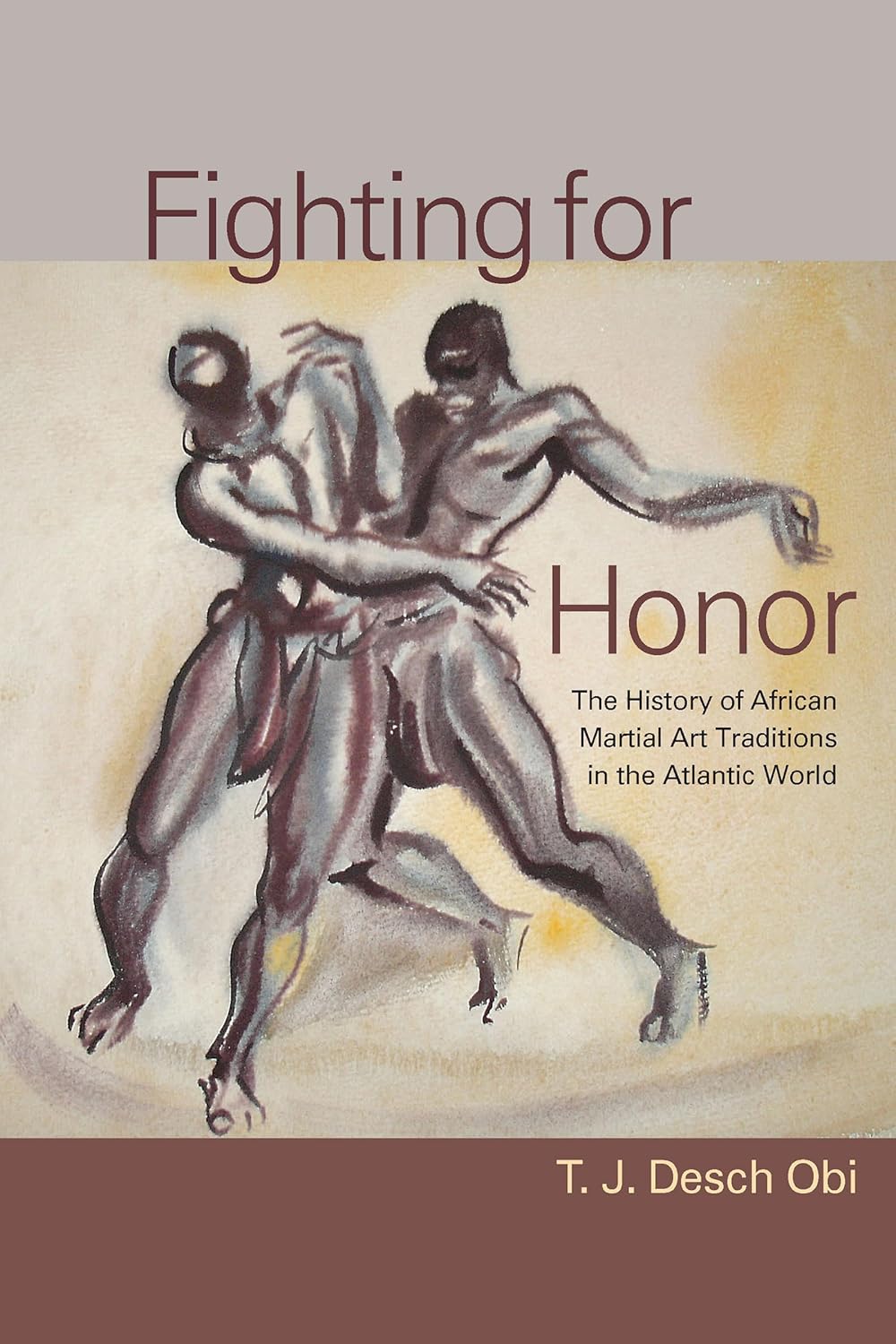
Fighting for Honor: The History of African Martial Art in the Atlantic World
Book Summary
A groundbreaking investigation into the migration of martial arts techniques across continents and centuries The presence of African influence and tradition in the Americas has long been recognized in art, music, language, agriculture, and religion. T. J. Desch-Obi explores another cultural continuity that is as old as eighteenth-century slave settlements in South America and as contemporary as hip-hop culture. In this thorough survey of the history of African martial arts techniques, Desch-Obi maps the translation of numerous physical combat techniques across three continents and several centuries to illustrate how these practices evolved over time and are still recognizable in American culture today. Some of these art traditions were part of African military training while others were for self-defense and spiritual discipline. Grounded in historical and cultural anthropological methodologies, Desch-Obi’s investigation traces the influence of well-delineated African traditions on long-observed but misunderstood African and African American cultural activities in North America, Brazil, and the Caribbean. He links the Brazilian martial art capoeira to reports of slave activities recorded in colonial and antebellum North America. Likewise Desch-Obi connects images of the kalenda African stick-fighting techniques to the Haitian Revolution. Throughout the study Desch-Obi examines the ties between physical mastery of these arts and changing perceptions of honor. Including forty-five illustrations, this rich history of the arrival and dissemination of African martial arts in the Atlantic world offers a new vantage for furthering our understanding of the powerful influence of enslaved populations on our collective social history.
Gil Scott-Heron was born in Chicago, Illinois, but spent his early childhood in the home of his grandmother Lillie Scott (mother’s family) in Jackson, Tennessee. Gil’s mother Bobbie Scott-Heron sang with the New York Oratorial Society. Gil’s father was a professional soccer player and is also a poet. His father’s family is of Jamaican descent. When he was 13, his grandmother died and he moved with his mother to the Bronx, where he enrolled in DeWitt Clinton High School. He transferred to The Fieldston School after one of his teachers, a Fieldston graduate, showed one of his writings to the head of the English department there and he was granted a full scholarship. Gil attended Lincoln University because it was the college of choice by his biggest influence Langston Hughes. It was at Lincoln University that Gil met Brian Jackson and they formed the band Black & Blues. After about two years at Lincoln University in Pennsylvania, Scott-Heron took a year off to write a novel The Vulture. He returned to New York City, settling in Chelsea, Manhattan, which was at the time a multiracial and multicultural neighborhood. The novel, The Vulture, was published in 1970 and well received. Although Gil never received his undergraduate degree, he has a Masters in Creative Writing from Johns Hopkins University.
Scott-Heron began his recording career in 1970 with the LP Small Talk at 125th and Lenox. Bob Thiele of Flying Dutchman Records produced the album and Scott-Heron was accompanied by Eddie Knowles and Charlie Saunders on conga and David Barnes on percussion and vocals. The album’s 15 tracks dealt with themes such as the superficiality of television and mass consumerism, the hypocrisy of some would-be Black revolutionaries, white middle-class ignorance of the difficulties faced by inner-city residents, and fear of homosexuals. In the liner notes, Scott-Heron acknowledged as influences Richie Havens, John Coltrane, Otis Redding, Jose Feliciano, Billie Holiday, Langston Hughes, Malcolm X, Huey Newton, Nina Simone, and the pianist who would become his long-time collaborator, Brian Jackson.
Scott-Heron’s 1971 album Pieces of a Man used more conventional song structures than the loose, spoken-word feel of Small Talk. He was joined by Johnny Pate (conductor), Brian Jackson (piano and electric piano), Ron Carter (bass and electric bass), Bernard Pretty Purdie (drums), Burt Jones (electric guitar), and Hubert Laws (flute and saxophone), with Thiele producing again. Scott-Heron’s third album, Free Will, was released in 1972. Jackson, Purdie, Laws, Knowles, and Saunders all returned to play on Free Will and were joined by Jerry Jemmott (bass), David Spinozza (guitar), and Horace Ott (arranger and conductor).
1974 saw another LP collaboration with Brian Jackson, Winter in America, with Bob Adams on drums and Danny Bowens on bass. He didn’t reach the charts until 1975 with the song Johannesburg, from the album From South Africa to South Carolina. That year he and Jackson also released Midnight Band: The First Minute of a New Day. A live album, It’s Your World, followed in 1976 and a recording of spoken poetry, The Mind of Gil Scott-Heron was released in 1979. His biggest hit came with a song called Angel Dust, which he recorded as a single with producer Malcolm Cecil. Angel Dust peaked at #15 on the R&B charts in 1978.
In 1979, Scott-Heron played at the No Nukes concerts at Madison Square Garden. The concerts were organized after the Three Mile Island accident by Musicians United for Safe Energy to protest the use of nuclear energy. Scott-Heron’s song We Almost Lost Detroit, about a previous accident at a nuclear facility, was included in the No Nukes album of concert highlights.
During the 1980s, Scott-Heron continued recording, releasing Reflections in 1981 and Moving Target in 1982.
Scott-Heron was a frequent critic of President Ronald Reagan and his conservative policies:
“The idea concerns the fact that this country wants nostalgia. They want to go back as far as they can — even if it’s only as far as last week. Not to face now or tomorrow, but to face backwards. And yesterday was the day of our cinema heroes riding to the rescue at the last possible moment. The day of the man in the white hat or the man on the white horse – or the man who always came to save America at the last moment — someone always came to save America at the last moment — especially in ‘B’ movies. And when America found itself having a hard time facing the future, they looked for people like John Wayne. But since John Wayne was no longer available, they settled for Ronald Reagan — and it has placed us in a situation that we can only look at — like a ‘B’ movie.” (Gil Scott-Heron, “‘B’ Movie”)
Scott-Heron was dropped by Arista Records in 1985 and quit recording, though he continued to tour. He also appeared in the Sun City (album) track, “Let Me See Your ID” in 1985.
In 1993, he signed to TVT Records and released Spirits, an album that included the seminal track Message to the Messengers. The first track on the album was a position point poem to the rap artists of the day and included such comments as:
* “Four-letter words or four-syllable words won’t make you a poet, it will only magnify how shallow you are and let ev’rybody know it.”
* “Tell all them gun-totin’ young brothers that the ‘man’ is glad to see us out there killin’ one another! We raised too much hell, when they was shootin’ us down.”
* “Young rappers, one more suggestion, before I get outta your way. I appreciate the respect you give to me and what you’ve got to say.”
Scott-Heron is known in many circles as “the godfather of rap” and is widely considered to be one of the genre’s founding fathers. Given the political consciousness that lies at the foundation of his work, he can also be called a founder of political rap. Message to the Messengers was a plea for the new generation of rappers to speak for change rather than perpetuate the current social situation, and to be more articulate and artistic:
“There’s a big difference between putting words over some music, and blending those same words into the music. There’s not a lot of humour. They use a lot of slang and colloquialisms, and you don’t really see inside the person. Instead, you just get a lot of posturing.”
In 2001, Gil Scott-Heron was sentenced to one to three years’ imprisonment in New York State for cocaine possession. While out of jail in 2002, he appeared on the Blazing Arrow album by Blackalicious. He was released on parole in 2003.
On July 5, 2006, Scott-Heron was sentenced to two to four years in a New York State prison for violating a plea deal on a drug-possession charge by leaving a treatment center. Scott-Heron said he is HIV-positive and claimed the in-patient rehabilitation center stopped giving him his medication. The prosecution countered that Scott-Heron had once skipped out for an appearance with singer Alicia Keys. Scott-Heron’s sentence was to run until July 13, 2009. He was paroled on May 23, 2007. He has since begun performing live again, starting with a show at SOBs in New York on 13 September 2007. On stage, he stated that he and his musicians were working on a new album, and that he had resumed writing a book entitled “The Last Holiday” (previously on long-term hiatus) about Stevie Wonder and his successful attempt to have Martin Luther King’s birthday made a national holiday in the USA. Gil was arrested October 10, the day before a second SOB’S performance scheduled for October 11, 2007 on felony possession of cocaine charges.
Scott-Heron’s father, Giles “Gil” Heron (nicknamed “The Black Arrow”) was a Jamaican football player who played for Glasgow’s Celtic Football Club in the 1950s. In fact, when he came to Scotland from the United States to join Celtic in 1951 he became the team’s first black player. At the time, Celtic F.C. was the team of Scotland’s Irish immigrants. However, Gil himself has said that he supports Celtic’s great rivals, Rangers.
Mark T. Watson, a student of Scott-Heron’s work, dedicated a collection of poetry to Gil entitled Ordinary Guy which also contained a foreword by Jalal Mansur Nuriddin of The Last Poets. The book was published in the UK in 2004 by Fore-Word Press Ltd. Gil recorded one of the poems in Mark T. Watson’s book entitled “Black & Blue” due for release in 2008 as part of the album “Rhythms of the Diaspora” by Malik & the OG’s on the label “CPR recordings”.
..Slavery is being practiced by the system under the color of law…. Slavery 400 years ago, slavery today; it’s the same thing, but with a new name. They’re making millions and millions of dollars enslaving blacks, poor whites, and others–people who don’t even know they’re being railroaded.–Political Prisoner Ruchell Magee [1]
Despite a chilling official silence, 1995 was a bombshell in the “war on crime.” In this one year alone, 150 new prisons were built in the United States and 171 existing prisons were expanded. This was the year the crime bill was passed, mandating that 100,000 additional police officers be added to the already enormous law enforcement establishment. In California, this was the first year that the state budget allocated more money for prisons than higher education. Most astonishingly, with one short day of media attention, 1995 was the year that Alabama’s governor Fob James, and other state officials, made the callous and horrifying decision to reinstate the nationally abolished chain gang.
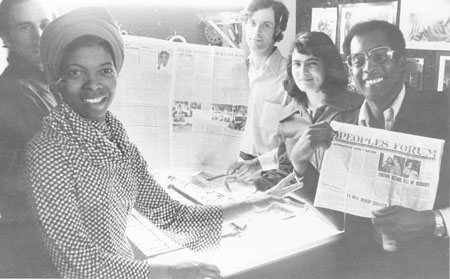
Peoples Temple staff members holding the first large format, newsprint issue of Peoples Forum in December 1976. Left to right: Tim Carter, Frances Johnson, Tim Clancey, Gloria Rodriguez (Carter), Jim Ingram. Photo courtesy of Tim Carter.
Were the deaths in Jonestown murder or suicide? It is an important question, one that I feel demands to be addressed and debated. Why? Because it is the core perception of what transpired in Jonestown on that horrible, tragic day.
Jonestown has become a punch line, a catch phrase, an icon for “mindless or blind loyalty.” Ironically, what Jonestown has come to represent in popular culture is a parody of itself: The general public is “drinking the Kool-Aid” in its unquestioned acceptance of what happened in Jonestown as “mass suicide.”
I assert that the vast majority of those who died in Jonestown that day were murdered.
I will break down those whom I consider to be murdered, beginning with the group of people who were forcibly injected with poison. This is a historical fact that no documentary or film has yet chosen to discuss or even portray. In every interview I’ve ever given, I’ve spoken about the bodies that I personally saw with abscesses. And yet, that fact is never reported. Could it be that this reality is left out of media portrayals because it doesn’t fit neatly into the “mass suicide” argument?
On November 20th, I, and two others, were asked (i.e. told) to return to Jonestown to help identify bodies, a task and experience nearly as traumatizing and painful as the final day itself. While attempting to identify bodies, I viewed many (at least two dozen) that had huge protruding abscesses. I stayed in a very self-proscribed area within the pavilion itself, as I refused to identify bodies in any other location. Too, while doing my best to make identifications, I did not physically move or rearrange any of the deceased to see if the individuals underneath met a similar demise.
The location of these injections was haphazard and varied, despite the testimony of Guyana’s chief pathologist Dr. Leslie Mootoo at the inquest in Matthews Ridge that all injections were found located between the shoulder blades. I personally saw abscesses on a left temple, neck, back of hand, upper arm, lower leg, cheek, and back of shoulder. I believe Dr. Mootoo was describing the bodies found in the “dorm” where Hyacinth Thrash and other older seniors lived.
The numbers of people forcibly injected with poison will never be fully known. During the first days following November 18, Dr. Mootoo gave a range in his count, from 70-80 to over 180,[1] and this was on the limited number of bodies – perhaps no more than 200 – that he says he was able to inspect before the U.S. State Department took over the “recovery” operation on November 22. What is most disturbing is that when Dr. Mootoo testified at the inquest, he said the number was fewer than 20. Why? What would account for such a drastic reduction to a number below what I personally saw in a very small area inside the pavilion.
There are some survivors who believe that some outside force came into Jonestown and injected the bodies post-mortem in an attempt to make it look like murder. To those people I say. listen to the words of another eye-witness, who in a television interview done shortly after the tragedy described what he saw: people who did not cooperate were injected with poison where they sat, or were held down and injected with poison.
The Final Report: Jonestown Tragedy, the National Geographic Channel documentary on Jonestown which premiered in November 2006, summarized what happened in Jonestown thusly (paraphrasing): “Two hundred forty six children were murdered, but the adults were ready to die.”
I’m sure those that were forcibly injected with poison would be aghast and shocked to hear that they were “ready to die,” and that their struggle to live has become instead an icon for meekly surrendering.
* * * * *
So how does one break down the numbers? Out of the 913 people who died in Jonestown, I account for “those murdered” thusly:
• I know of no one who would argue that children don’t commit suicide, and were murdered. Using National Geographic’s count, that is 246.
• The numbers of seniors (over 65) numbered approximately 180. Almost no one would argue that those unable to defend themselves would be anything other than “murdered.”
• The numbers of people injected with poison: For the purposes of this debate, I will split the difference between 70 and 181, arriving at 125. If I saw so many individuals with abscesses in such a proscribed area, I feel the 125 number is a reasonable approximation.
We now have 246 children, 180 seniors over age 65, and approximately 125 injected with poison. That brings us to 551 out of 913, or 60 percent.
However, I assert there are other groups of people who should fall into the category of being murdered:
• Those who drank poison believing that they had only two choices: drink the poison, or be shot by armed guards. Is that “revolutionary suicide”? No, it is not. Their deaths were coerced. The pavilion was surrounded by armed guards. People witnessed others being pulled from their seats and forced to drink or being injected.
• Those who may have voluntarily drunk the poison based on the lies of Jim Jones as told that day. Jones asserted that the children would be taken from us, that the Guyanese Defense Force was on its way and it was armed and would be shooting, etc. If someone “voluntarily” takes their life based on the lies of another, is that really suicide? Wouldn’t the perpetrator of the lie be responsible?
• Those who voluntarily drank the poison through months/years of conditioning that created a state-of-siege mentality. Oftentimes, as many survivors have learned since, the “crises” we were experiencing were – literally – manufactured by Jones himself (e.g. gun shots being fired into the community in September of ‘77). If one commits “revolutionary suicide” based on years of experience, without the knowledge that the experiences themselves were created by the leader, is that suicide? I assert it is murder.
How does one assign a numerical total to the people who fall into the above categories? It is impossible. Perhaps one guideline would be this: During the so-called “September Siege” of 1977, Jones twice asked the approximately 700 people in Jonestown “Who wants to commit revolutionary suicide?” The first vote revealed a total of two who voted “for” (Maria Katsaris and Harriett Tropp). The following day the total rose to three (Carolyn Layton, along with Maria and Harriett).
That constitutes less than one percent of Jonestown’s population who felt revolutionary suicide was an option. Were the percentages higher on November 18, 1978? I say no, not discernibly. Those who were not in Jonestown on that day bolster that argument. Of the approximately 300 or so full-time members who were not in Jonestown, only two committed suicide (one after murdering her children). Again, we are left with a figure of around one percent.
Giving much room for debate, I will say that 75 per cent of those 361 in the above named categories did not commit suicide (though, personally, I feel it is higher). That is 278 people, which – when added to the children and seniors and those injected with poison – brings us to a total of 829 people murdered, or ninety percent.
Finally, I use Jim Jones’ own words, taken from the so-called “death” tape, to refute the assertion that the majority of people meekly acquiesced in their death: “Don’t lay it [your life] down with tears and agony. Stop this hysterics! This is not the way for [people] to die.”
Jones himself tells the world what was happening in Jonestown: Tears. Agony. Hysteria. I can attest that agony and tears and hysteria (and fear) were the operative emotions of that day. The screams heard on the so-called “death” tape were far louder than those which come through on the tape itself.
Mass suicide? Or mass murder? While some did commit suicide, the vast majority of those who perished in Jonestown were murdered. Jonestown should always be considered a mass murder, with some suicide.
Not the stuff that makes for a good catch-phrase or punch-line.
Note
[1] Other articles elsewhere on the Net and on this website – including two others by Joey Dieckman and Jim Hougan in this forum on the question of murder and suicide– give different figures for the number of bodies that Dr. Mootoo examined and the number of injection marks he saw.
The discrepancies come from Mootoo himself, who reported various numbers from his time at the scene in Jonestown, from the Guyanese inquest held within a few weeks, and from later interviews. That those numbers varied in the telling may be attributable to the fact that Dr. Mootoo gave his specimens and samples to “a representative of the American Embassy in Georgetown, expecting that they would be forwarded to American forensic pathologists.” They were not, and no one knows what happened to them.
It is now impossible to reconcile the discrepancies and present a definitive number, since Dr. Mootoo died many years ago, and records of the Jonestown deaths are not longer available from the Armed Forces Institute of Pathology or any other government agency known to have forensic evidence from Jonestown.
(Tim Carter lived in Jonestown and escaped on the final day. His report on the November 18 Memorial Food Fund appears here. His complete collection of writings for the jonestown report may be found here.)
I present this lesson to make a simple point – the digital divide is the development divide. Not only is that underdevelopment most dramatically manifested in sub-Shara Africa, but even more frightening to me is what I see in my own community. Those without access and training (our youth and children) can’t participate in the opportunities ICT might bring; whether economic, social, political or academic. If we in the “Nationalist-PanAfrikanist” fold don’t began to take responsibility for planning, developing and implementing ICT (Information and Communication Technology) programs and projects for our people, who will? RBG Street Scholars Think Tank has such a plan, but requires cooperation to move forward.
A World of Information
The University of Hawaii investigates the world of information, communications, the media, and technology; and its effects on society and culture through interviews with scholars, United Nations officials, media critics and TV news professionals. Subjects tackled include the battle over media ownership; the controversy over international copyright law; the state of American journalism; and the media’s impact on culture. – ResearchChannel is a nonprofit media and technology organization that connects a global audience with the research and academic institutions whose developments, insights and discoveries affect our lives and futures.
Link to the video/embedding not available However if you are using snap preview, as I have suggested, you may view the video here:




 RBG Communiversity: Message 2 Da Grassroots
You must be logged in to post a comment.