Asafo : A Political-Military Institution of the Akan

The asafo is a political-military institution of the Akan. Even though its social and political functions have been well documented, the expressive and aesthetic culture of the Asafo institution has received limited scholarly attention (de Graft Johnson, 1932; Fortes and Evans-Pritchard, 1940; Datta and Porter, 1971; and Sutherland-Addy, 1998). Sutherland-Addy (1998, p. 90), for example, suggests that “the rhetoric, libations, historical songs and chants, praise-poetry, legends and drama texts may now be examined with a view to demonstrating how they provide the texture, context, impact and value of historical fact” that mark the asafo institution.
Even though the Akan societies, had no standing army, the asafo – i.e., a people’s militia – was a well established social and political organization based on martial principles. Every able-bodied person belonged to an asafo group; every child automatically belonged to his or her father’s company.Internal sub-divisions within an individual company included the main fighting body, the scouts, reserves, and the minstrel unit whose main job it was to sing patriotic and war songs to boost the morale of the military.The asafo companies forming the national army were organized into main fighting divisions thus: adonten (vanguard – main body under the adontenhene), twafo (advance guard), kyidom (rearguard – under the kyidomhene), nifa (right wing under the nifahene), benkum (left wing under the benkumhene), akwansra (scouting division), ankobea (home guard under the ankobeahene), and gyaase (the king’s bodyguard under the gyaasehene).

Asafo companies were also differentiated by the different colors of headgear and hairstyles worn by members, exclusive drums, horns and other musical instruments, appellations, and emblems. Other units within the main divisions included afonasoafoo (the carriers of spears and shields), sumankwaafoo (the herbalists and medicine men), and the asokwafo (heralds). Asafo companies existed in all the Akan states.

In Asante, the national asafo was commanded by the Asantehene, but two generals, the kurontire and akwamu, were the military leaders. The Fantse went a step further by incorporating some European customs in their Asafo companies.

The typical Asafo company in a Fantse township, according to Aggrey (1978), was headed by the Tufohene, the military advisor to the chief of the township. Next in line is the Asafobaatan. Supi was the commanding officer, while the divisional captain within a company was called the Safohene (for the male) or Asafoakyere (for the female). Other ranks in the Asafo were the Asafokomfo (the priest), okyerema – head of the akyeremafo (the drummers), frankaakitani (flag bearer), sekanboni (sword maker), okyeame (spokesperson or linguist), and abrafoo (police officers) and adumfoo (executioners).

 

RBG Glossary of Terms| Goals of Mis-Education vs. Liberatory Practices and Decolonizing the African Mind_Dr. Uhuru Hotep + Talib Kweli Feat. RBG Street Scholar- Ballad Of The Black Gold

Updated, March 2024

Click for standalone poster.

We Are Afrikan People Wherever We Were Born No matter where we were born in the world. Afrikan (Black) People are historically and culturally linked. Our history, identity, and culture are rooted in the many thousands of years of development of Afrikan civilization on the Afrikan continent. This is a consequence of the ever forward movement and motion of the New Afrikan masses. It is from this historical march of our people (Afrikan [Black] People) that we derive our African culture, the sum total of material and spiritual values created by our people. It is this invincible weapon, Afrikan culture, that has always served to fight against all forms of oppression and exploitation, to move forward New Afrikan People and Afrikan civilization.”

Pop the document out from the upper right to read / expand / download.

The Influence of Marcus Garvey| “Look for me in the Whirlwind”

“Look for me in the Whirl wind”


Black nationalism originated in the 1850’s. While the origins of the movement are most commonly associated with Marcus Garvey’s Universal Negro Improvement Association (UNIA) of the 1920s, Garvey was preceded and influenced by Martin Delany, Henry Sylvestre-Williams, Dr. Robert Love and Edward Wilmot Blyden. Even though the future of Africa is seen as being central to Black nationalist ambitions, some adherents to Black nationalism are intent on the eventual creation of a separate black nation by Africans in American.
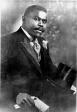
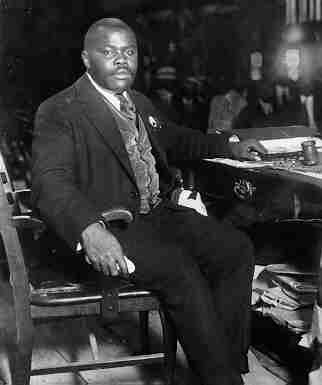
Born in St. Ann’s Bay, Jamaica, on August 17, 1887, Marcus Garvey was the youngest of 11 children. Garvey moved to Kingston at the age of 14, found work in a printshop, and became acquainted with the abysmal living conditions of the laboring class. He quickly involved himself in social reform, participating in the first Printers’ Union strike in Jamaica in 1907 and in setting up the newspaper The Watchman. Leaving the island to earn money to finance his projects, he visited Central and South America, amassing evidence that black people everywhere were victims of discrimination. He visited the Panama Canal Zone and saw the conditions under which the West Indians lived and worked. He went to Ecuador, Nicaragua, Honduras, Colombia and Venezuala. Everywhere, blacks were experiencing great hardships.
Garvey returned to Jamaica distressed at the situation in Central America, and appealed to Jamaica’s colonial government to help improve the plight of West Indian workers in Central America. His appeal fell on deaf ears. Garvey also began to lay the groundwork of the Universal Negro Improvement Association, to which he was to devote his life. Undaunted by lack of enthusiasm for his plans, Garvey left for England in 1912 in search of additional financial backing. While there, he met a Sudanese-Egyptian journalist, Duse Mohammed Ali. While working for Ali’s publication African Times and Oriental Review, Garvey began to study the history of Africa, particularly, the exploitation of black peoples by colonial powers. He read Booker T. Washington’s Up From Slavery, which advocated black self-help.
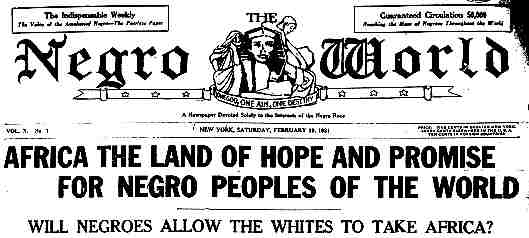
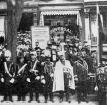
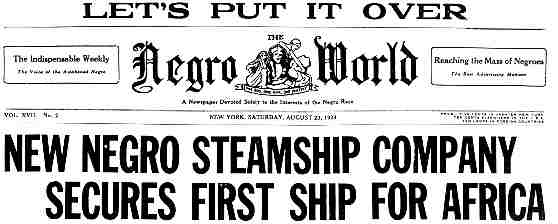
In 1914 Garvey organized the Universal Negro Improvement Association and its coordinating body, the African Communities League. In 1920 the organization held its first convention in New York. The convention opened with a parade down Harlem’s Lenox Avenue. That evening, before a crowd of 25,000, Garvey outlined his plan to build an African nation-state. In New York City his ideas attracted popular support, and thousands enrolled in the UNIA. He began publishing the newspaper The Negro World and toured the United States preaching black nationalism to popular audiences. His efforts were successful, and soon, the association boasted over 1,100 branches in more than 40 countries. Most of these branches were located in the United States, which had become the UNIA’s base of operations. There were, however, offices in several Caribbean countries, Cuba having the most. Branches also existed in places such as Panama, Costa Rica, Ecuador, Venezuela, Ghana, Sierra Leone, Liberia, Namibia and South Africa. He also launched some ambitious business ventures, notably the Black Star Shipping Line.

In the years following the organization’s first convention, the UNIA began to decline in popularity. With the Black Star Line in serious financial difficulties, Garvey promoted two new business organizations – the African Communities League and the Negro Factories Corporation. He also tried to salvage his colonization scheme by sending a delegation to appeal to the League of Nations for transfer to the UNIA of the African colonies taken from Germany during World War I.
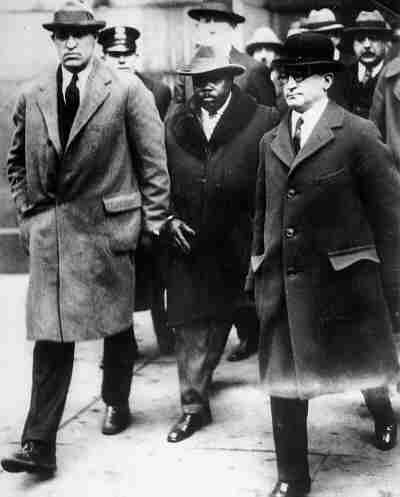
Financial betrayal by trusted aides and a host of legal entanglements (based on charges that he had used the U.S. mail to defraud prospective investors) eventually led to Garvey’s imprisonment in Atlanta Federal Penitentiary for a five-year term. In 1927 his half-served sentence was commuted, and he was deported to Jamaica by order of President Calvin Coolidge.Garvey then turned his energies to Jamaican politics, campaigning on a platform of self-government, minimum wage laws, and land and judicial reform. He was soundly defeated at the polls, however, because most of his followers did not have the necessary voting qualifications.In 1935 Garvey left for England where, in near obscurity, he died on June 10, 1940, in a cottage in West Kensington.


The Influence of Marcus Garvey| “Look for me in the Whirlwind”

“Look for me in the Whirl wind”


Black nationalism originated in the 1850’s. While the origins of the movement are most commonly associated with Marcus Garvey’s Universal Negro Improvement Association (UNIA) of the 1920s, Garvey was preceded and influenced by Martin Delany, Henry Sylvestre-Williams, Dr. Robert Love and Edward Wilmot Blyden. Even though the future of Africa is seen as being central to Black nationalist ambitions, some adherents to Black nationalism are intent on the eventual creation of a separate black nation by Africans in American.
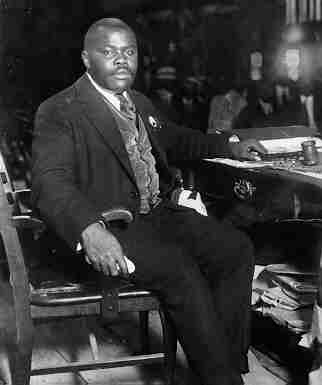
Born in St. Ann’s Bay, Jamaica, on August 17, 1887, Marcus Garvey was the youngest of 11 children. Garvey moved to Kingston at the age of 14, found work in a printshop, and became acquainted with the abysmal living conditions of the laboring class. He quickly involved himself in social reform, participating in the first Printers’ Union strike in Jamaica in 1907 and in setting up the newspaper The Watchman. Leaving the island to earn money to finance his projects, he visited Central and South America, amassing evidence that black people everywhere were victims of discrimination. He visited the Panama Canal Zone and saw the conditions under which the West Indians lived and worked. He went to Ecuador, Nicaragua, Honduras, Colombia and Venezuala. Everywhere, blacks were experiencing great hardships.
Garvey returned to Jamaica distressed at the situation in Central America, and appealed to Jamaica’s colonial government to help improve the plight of West Indian workers in Central America. His appeal fell on deaf ears. Garvey also began to lay the groundwork of the Universal Negro Improvement Association, to which he was to devote his life. Undaunted by lack of enthusiasm for his plans, Garvey left for England in 1912 in search of additional financial backing. While there, he met a Sudanese-Egyptian journalist, Duse Mohammed Ali. While working for Ali’s publication African Times and Oriental Review, Garvey began to study the history of Africa, particularly, the exploitation of black peoples by colonial powers. He read Booker T. Washington’s Up From Slavery, which advocated black self-help.
In 1914 Garvey organized the Universal Negro Improvement Association and its coordinating body, the African Communities League. In 1920 the organization held its first convention in New York. The convention opened with a parade down Harlem’s Lenox Avenue. That evening, before a crowd of 25,000, Garvey outlined his plan to build an African nation-state. In New York City his ideas attracted popular support, and thousands enrolled in the UNIA. He began publishing the newspaper The Negro World and toured the United States preaching black nationalism to popular audiences. His efforts were successful, and soon, the association boasted over 1,100 branches in more than 40 countries. Most of these branches were located in the United States, which had become the UNIA’s base of operations. There were, however, offices in several Caribbean countries, Cuba having the most. Branches also existed in places such as Panama, Costa Rica, Ecuador, Venezuela, Ghana, Sierra Leone, Liberia, Namibia and South Africa. He also launched some ambitious business ventures, notably the Black Star Shipping Line.

In the years following the organization’s first convention, the UNIA began to decline in popularity. With the Black Star Line in serious financial difficulties, Garvey promoted two new business organizations – the African Communities League and the Negro Factories Corporation. He also tried to salvage his colonization scheme by sending a delegation to appeal to the League of Nations for transfer to the UNIA of the African colonies taken from Germany during World War I.
Financial betrayal by trusted aides and a host of legal entanglements (based on charges that he had used the U.S. mail to defraud prospective investors) eventually led to Garvey’s imprisonment in Atlanta Federal Penitentiary for a five-year term. In 1927 his half-served sentence was commuted, and he was deported to Jamaica by order of President Calvin Coolidge.Garvey then turned his energies to Jamaican politics, campaigning on a platform of self-government, minimum wage laws, and land and judicial reform. He was soundly defeated at the polls, however, because most of his followers did not have the necessary voting qualifications.In 1935 Garvey left for England where, in near obscurity, he died on June 10, 1940, in a cottage in West Kensington.