

Click Menu for Related Videos
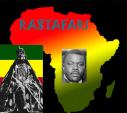
 Rastafari is a movement of Black people who know Africa as the birthplace of Mankind and the throne of Emperor Haile Selassie I — a 20th Century Manifestation of God who has lighted our pathway towards righteousness, and is therefore worthy of reverence.
The Rastafari movement grew out of the darkest depression that the descendants of African slaves in Jamaica have ever lived in — the stink and crumbling shacks of zinc and cardboard that the tattered remnants of humanity built on the rotting garbage of the dreadful Dungle on Kingston’s waterfront. Out of this filth and slime arose a sentiment so pure, so without anger, so full of love, the Philosophy of the Rastafari faith.
Freedom of Spirit, Freedom from Slavery, and Freedom of Africa, was its cry.
Religions always reflect the social and geographical environment out of which they emerge, and Jamaican Rastafarianism is no exception: for example, the use of marijuana as a sacrament and aid to meditation is logical in a country where a particularly strain of ‘herb’ grows freely. Emerging out of the island of Jamaica in the later half of this century, the religious/political movement known as Rastafarianism has gained widespread exposure in the Western world.
Rasta, as it is more commonly called, has its roots in the teachings of Jamaican black nationalist Marcus Garvey, who in the 1930s preached a message of black self empowerment, and initiated the “Back to Africa” movement. Which called for all blacks to return to their ancestral home, and more specifically Ethiopia. He taught self reliance “at home and abroad” and advocated a “back to Africa” consciousness, awakening black pride and denouncing the white man�s eurocentric woldview, colonial indoctrination that caused blacks to feel shame for their African heritage. “Look to Africa”, said Marcus Garvey in 1920, “when a black king shall be crowned, for the day of deliverance is at hand”. Many thought the prophecy was fulfilled when in 1930, Ras Tafari, was crowned emperor Haile Selassie 1 of Ethiopia and proclaimed “King of Kings, Lord of Lords, and the conquering lion of the Tribe of Judah”. Haile Selassie claimed to be a direct descendant of King David, the 225th ruler in an unbroken line of Ethiopian Kings from the time of Solomon and Sheba. He and his followers took great pride in being black and wanted to regain the black heritage that was lost by loosing faith and straying from the holy ways.
Rastafarians live a peaceful life, needing little material possessions and devote much time to contemplating the scriptures. They reject the white man’s world, as the new age Babylon of greed and dishonesty. Proud and confident Rastas even though they are humble will stand up for their rights. Rastas let their hair grow natually into dreadlocks, in the image of the lion of Judah. Six out of ten Jamaicans are believed to be Rastafarians or Rastafarian sympathizers. The total following is believed to be over 1000 000 worldwide. 1975 to the present has been the period of the most phenomenal growth for the Rastafarian Movement. This growth is largely attributed to Bob Marley, reggae artist, and the worldwide acceptance of reggae as an avenue of Rastafarian self-expression. Marley became a prophet of Rastafarianism in 1975. The movement spread quickly in the Caribbean and was hugely attractive to the local black youths, many of whom saw it as an extension of their adolescent rebellion from school and parental authority. With it came some undesirable elements, but all true Rastas signify peace and pride and righteousness…Read More
 RBG Communiversity: Message 2 Da Grassroots
You must be logged in to post a comment.