..Slavery is being practiced by the system under the color of law…. Slavery 400 years ago, slavery today; it’s the same thing, but with a new name. They’re making millions and millions of dollars enslaving blacks, poor whites, and others–people who don’t even know they’re being railroaded.–Political Prisoner Ruchell Magee [1]
Despite a chilling official silence, 1995 was a bombshell in the “war on crime.” In this one year alone, 150 new prisons were built in the United States and 171 existing prisons were expanded. This was the year the crime bill was passed, mandating that 100,000 additional police officers be added to the already enormous law enforcement establishment. In California, this was the first year that the state budget allocated more money for prisons than higher education. Most astonishingly, with one short day of media attention, 1995 was the year that Alabama’s governor Fob James, and other state officials, made the callous and horrifying decision to reinstate the nationally abolished chain gang.
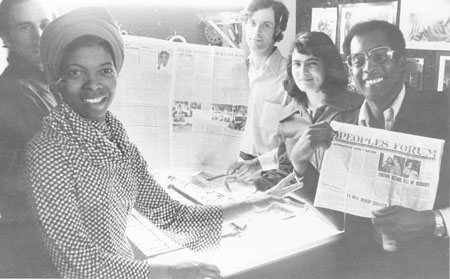
Peoples Temple staff members holding the first large format, newsprint issue of Peoples Forum in December 1976. Left to right: Tim Carter, Frances Johnson, Tim Clancey, Gloria Rodriguez (Carter), Jim Ingram. Photo courtesy of Tim Carter.
Were the deaths in Jonestown murder or suicide? It is an important question, one that I feel demands to be addressed and debated. Why? Because it is the core perception of what transpired in Jonestown on that horrible, tragic day.
Jonestown has become a punch line, a catch phrase, an icon for “mindless or blind loyalty.” Ironically, what Jonestown has come to represent in popular culture is a parody of itself: The general public is “drinking the Kool-Aid” in its unquestioned acceptance of what happened in Jonestown as “mass suicide.”
I assert that the vast majority of those who died in Jonestown that day were murdered.
I will break down those whom I consider to be murdered, beginning with the group of people who were forcibly injected with poison. This is a historical fact that no documentary or film has yet chosen to discuss or even portray. In every interview I’ve ever given, I’ve spoken about the bodies that I personally saw with abscesses. And yet, that fact is never reported. Could it be that this reality is left out of media portrayals because it doesn’t fit neatly into the “mass suicide” argument?
On November 20th, I, and two others, were asked (i.e. told) to return to Jonestown to help identify bodies, a task and experience nearly as traumatizing and painful as the final day itself. While attempting to identify bodies, I viewed many (at least two dozen) that had huge protruding abscesses. I stayed in a very self-proscribed area within the pavilion itself, as I refused to identify bodies in any other location. Too, while doing my best to make identifications, I did not physically move or rearrange any of the deceased to see if the individuals underneath met a similar demise.
The location of these injections was haphazard and varied, despite the testimony of Guyana’s chief pathologist Dr. Leslie Mootoo at the inquest in Matthews Ridge that all injections were found located between the shoulder blades. I personally saw abscesses on a left temple, neck, back of hand, upper arm, lower leg, cheek, and back of shoulder. I believe Dr. Mootoo was describing the bodies found in the “dorm” where Hyacinth Thrash and other older seniors lived.
The numbers of people forcibly injected with poison will never be fully known. During the first days following November 18, Dr. Mootoo gave a range in his count, from 70-80 to over 180,[1] and this was on the limited number of bodies – perhaps no more than 200 – that he says he was able to inspect before the U.S. State Department took over the “recovery” operation on November 22. What is most disturbing is that when Dr. Mootoo testified at the inquest, he said the number was fewer than 20. Why? What would account for such a drastic reduction to a number below what I personally saw in a very small area inside the pavilion.
There are some survivors who believe that some outside force came into Jonestown and injected the bodies post-mortem in an attempt to make it look like murder. To those people I say. listen to the words of another eye-witness, who in a television interview done shortly after the tragedy described what he saw: people who did not cooperate were injected with poison where they sat, or were held down and injected with poison.
The Final Report: Jonestown Tragedy, the National Geographic Channel documentary on Jonestown which premiered in November 2006, summarized what happened in Jonestown thusly (paraphrasing): “Two hundred forty six children were murdered, but the adults were ready to die.”
I’m sure those that were forcibly injected with poison would be aghast and shocked to hear that they were “ready to die,” and that their struggle to live has become instead an icon for meekly surrendering.
* * * * *
So how does one break down the numbers? Out of the 913 people who died in Jonestown, I account for “those murdered” thusly:
• I know of no one who would argue that children don’t commit suicide, and were murdered. Using National Geographic’s count, that is 246.
• The numbers of seniors (over 65) numbered approximately 180. Almost no one would argue that those unable to defend themselves would be anything other than “murdered.”
• The numbers of people injected with poison: For the purposes of this debate, I will split the difference between 70 and 181, arriving at 125. If I saw so many individuals with abscesses in such a proscribed area, I feel the 125 number is a reasonable approximation.
We now have 246 children, 180 seniors over age 65, and approximately 125 injected with poison. That brings us to 551 out of 913, or 60 percent.
However, I assert there are other groups of people who should fall into the category of being murdered:
• Those who drank poison believing that they had only two choices: drink the poison, or be shot by armed guards. Is that “revolutionary suicide”? No, it is not. Their deaths were coerced. The pavilion was surrounded by armed guards. People witnessed others being pulled from their seats and forced to drink or being injected.
• Those who may have voluntarily drunk the poison based on the lies of Jim Jones as told that day. Jones asserted that the children would be taken from us, that the Guyanese Defense Force was on its way and it was armed and would be shooting, etc. If someone “voluntarily” takes their life based on the lies of another, is that really suicide? Wouldn’t the perpetrator of the lie be responsible?
• Those who voluntarily drank the poison through months/years of conditioning that created a state-of-siege mentality. Oftentimes, as many survivors have learned since, the “crises” we were experiencing were – literally – manufactured by Jones himself (e.g. gun shots being fired into the community in September of ‘77). If one commits “revolutionary suicide” based on years of experience, without the knowledge that the experiences themselves were created by the leader, is that suicide? I assert it is murder.
How does one assign a numerical total to the people who fall into the above categories? It is impossible. Perhaps one guideline would be this: During the so-called “September Siege” of 1977, Jones twice asked the approximately 700 people in Jonestown “Who wants to commit revolutionary suicide?” The first vote revealed a total of two who voted “for” (Maria Katsaris and Harriett Tropp). The following day the total rose to three (Carolyn Layton, along with Maria and Harriett).
That constitutes less than one percent of Jonestown’s population who felt revolutionary suicide was an option. Were the percentages higher on November 18, 1978? I say no, not discernibly. Those who were not in Jonestown on that day bolster that argument. Of the approximately 300 or so full-time members who were not in Jonestown, only two committed suicide (one after murdering her children). Again, we are left with a figure of around one percent.
Giving much room for debate, I will say that 75 per cent of those 361 in the above named categories did not commit suicide (though, personally, I feel it is higher). That is 278 people, which – when added to the children and seniors and those injected with poison – brings us to a total of 829 people murdered, or ninety percent.
Finally, I use Jim Jones’ own words, taken from the so-called “death” tape, to refute the assertion that the majority of people meekly acquiesced in their death: “Don’t lay it [your life] down with tears and agony. Stop this hysterics! This is not the way for [people] to die.”
Jones himself tells the world what was happening in Jonestown: Tears. Agony. Hysteria. I can attest that agony and tears and hysteria (and fear) were the operative emotions of that day. The screams heard on the so-called “death” tape were far louder than those which come through on the tape itself.
Mass suicide? Or mass murder? While some did commit suicide, the vast majority of those who perished in Jonestown were murdered. Jonestown should always be considered a mass murder, with some suicide.
Not the stuff that makes for a good catch-phrase or punch-line.
Note
[1] Other articles elsewhere on the Net and on this website – including two others by Joey Dieckman and Jim Hougan in this forum on the question of murder and suicide– give different figures for the number of bodies that Dr. Mootoo examined and the number of injection marks he saw.
The discrepancies come from Mootoo himself, who reported various numbers from his time at the scene in Jonestown, from the Guyanese inquest held within a few weeks, and from later interviews. That those numbers varied in the telling may be attributable to the fact that Dr. Mootoo gave his specimens and samples to “a representative of the American Embassy in Georgetown, expecting that they would be forwarded to American forensic pathologists.” They were not, and no one knows what happened to them.
It is now impossible to reconcile the discrepancies and present a definitive number, since Dr. Mootoo died many years ago, and records of the Jonestown deaths are not longer available from the Armed Forces Institute of Pathology or any other government agency known to have forensic evidence from Jonestown.
(Tim Carter lived in Jonestown and escaped on the final day. His report on the November 18 Memorial Food Fund appears here. His complete collection of writings for the jonestown report may be found here.)
I present this lesson to make a simple point – the digital divide is the development divide. Not only is that underdevelopment most dramatically manifested in sub-Shara Africa, but even more frightening to me is what I see in my own community. Those without access and training (our youth and children) can’t participate in the opportunities ICT might bring; whether economic, social, political or academic. If we in the “Nationalist-PanAfrikanist” fold don’t began to take responsibility for planning, developing and implementing ICT (Information and Communication Technology) programs and projects for our people, who will? RBG Street Scholars Think Tank has such a plan, but requires cooperation to move forward.
A World of Information
The University of Hawaii investigates the world of information, communications, the media, and technology; and its effects on society and culture through interviews with scholars, United Nations officials, media critics and TV news professionals. Subjects tackled include the battle over media ownership; the controversy over international copyright law; the state of American journalism; and the media’s impact on culture. – ResearchChannel is a nonprofit media and technology organization that connects a global audience with the research and academic institutions whose developments, insights and discoveries affect our lives and futures.
Link to the video/embedding not available However if you are using snap preview, as I have suggested, you may view the video here:
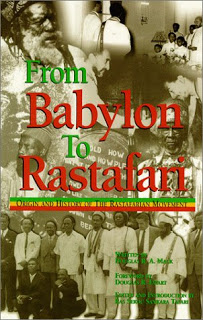
Rastafari is a movement of Black people who know Africa as the birthplace of Mankind and the throne of Emperor Haile Selassie I — a 20th Century Manifestation of God who has lighted our pathway towards righteousness, and is therefore worthy of reverence.
The Rastafari movement grew out of the darkest depression that the descendants of African slaves in Jamaica have ever lived in — the stink and crumbling shacks of zinc and cardboard that the tattered remnants of humanity built on the rotting garbage of the dreadful Dungle on Kingston’s waterfront. Out of this filth and slime arose a sentiment so pure, so without anger, so full of love, the Philosophy of the Rastafari faith.
Freedom of Spirit, Freedom from Slavery, and Freedom of Africa, was its cry.
Religions always reflect the social and geographical environment out of which they emerge, and Jamaican Rastafarianism is no exception: for example, the use of marijuana as a sacrament and aid to meditation is logical in a country where a particularly strain of ‘herb’ grows freely. Emerging out of the island of Jamaica in the later half of this century, the religious/political movement known as Rastafarianism has gained widespread exposure in the Western world.
Rasta, as it is more commonly called, has its roots in the teachings of Jamaican black nationalist Marcus Garvey, who in the 1930s preached a message of black self empowerment, and initiated the “Back to Africa” movement. Which called for all blacks to return to their ancestral home, and more specifically Ethiopia. He taught self reliance “at home and abroad” and advocated a “back to Africa” consciousness, awakening black pride and denouncing the white man�s eurocentric woldview, colonial indoctrination that caused blacks to feel shame for their African heritage. “Look to Africa”, said Marcus Garvey in 1920, “when a black king shall be crowned, for the day of deliverance is at hand”. Many thought the prophecy was fulfilled when in 1930, Ras Tafari, was crowned emperor Haile Selassie 1 of Ethiopia and proclaimed “King of Kings, Lord of Lords, and the conquering lion of the Tribe of Judah”. Haile Selassie claimed to be a direct descendant of King David, the 225th ruler in an unbroken line of Ethiopian Kings from the time of Solomon and Sheba. He and his followers took great pride in being black and wanted to regain the black heritage that was lost by loosing faith and straying from the holy ways.
Rastafarians live a peaceful life, needing little material possessions and devote much time to contemplating the scriptures. They reject the white man’s world, as the new age Babylon of greed and dishonesty. Proud and confident Rastas even though they are humble will stand up for their rights. Rastas let their hair grow natually into dreadlocks, in the image of the lion of Judah. Six out of ten Jamaicans are believed to be Rastafarians or Rastafarian sympathizers. The total following is believed to be over 1000 000 worldwide. 1975 to the present has been the period of the most phenomenal growth for the Rastafarian Movement. This growth is largely attributed to Bob Marley, reggae artist, and the worldwide acceptance of reggae as an avenue of Rastafarian self-expression. Marley became a prophet of Rastafarianism in 1975. The movement spread quickly in the Caribbean and was hugely attractive to the local black youths, many of whom saw it as an extension of their adolescent rebellion from school and parental authority. With it came some undesirable elements, but all true Rastas signify peace and pride and righteousness…Read More




 RBG Communiversity: Message 2 Da Grassroots
You must be logged in to post a comment.